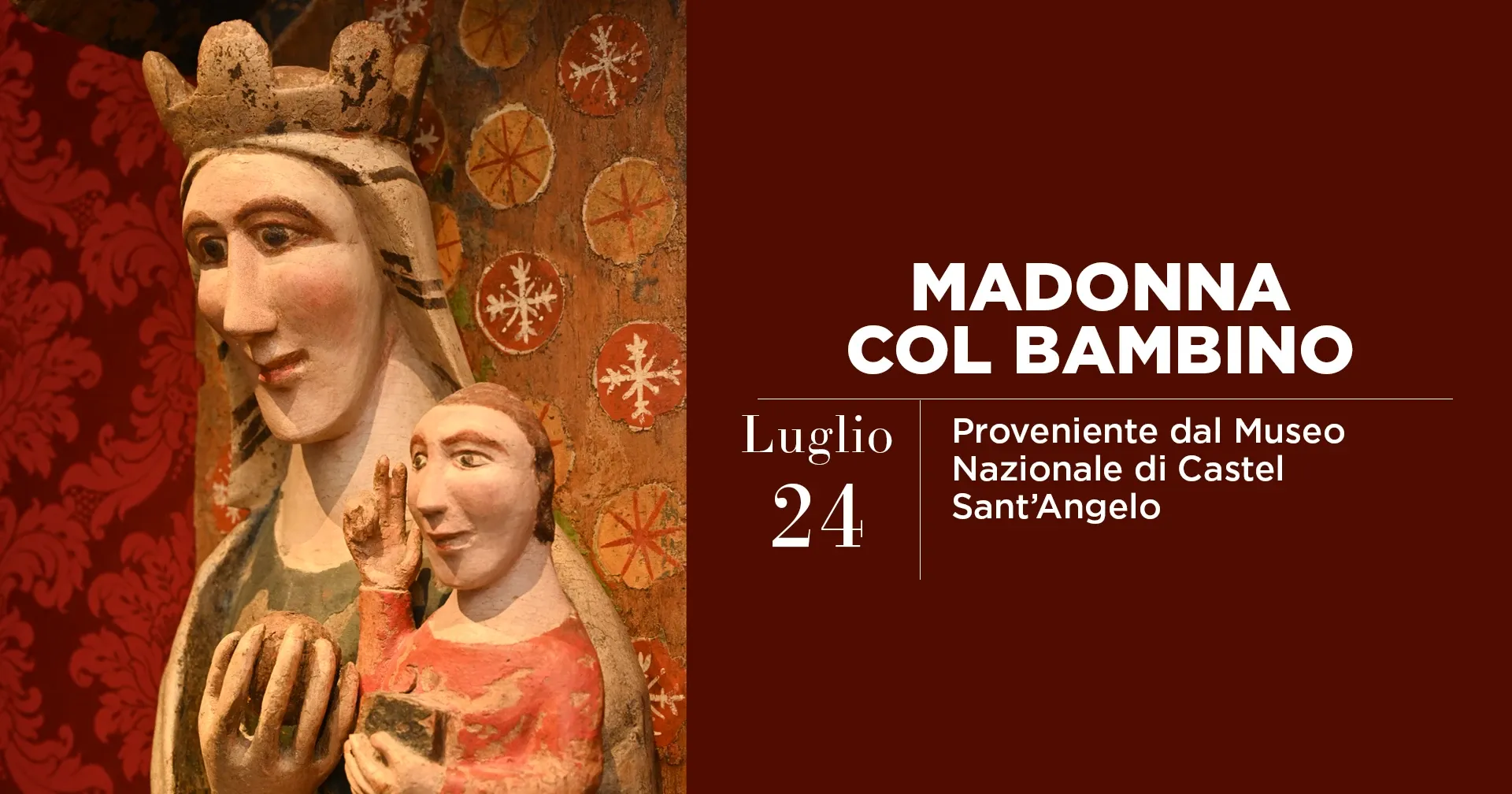

The fruit of a fruitful institutional collaboration between Castel Sant’Angelo and the National Museum of Abruzzo in L’Aquila, the Madonna and Child, a carved and painted wooden group, was presented at MuNDA on July 24th at 11:00 a.m., in the presence of authorities and the press.
Thanks to this agreement, promoted by the Directorate-General of Museums, within the framework and spirit of the National Museum System, an agreement was signed between the two museums, which provides for the deposit of the work at MuNDA for five years, renewable.
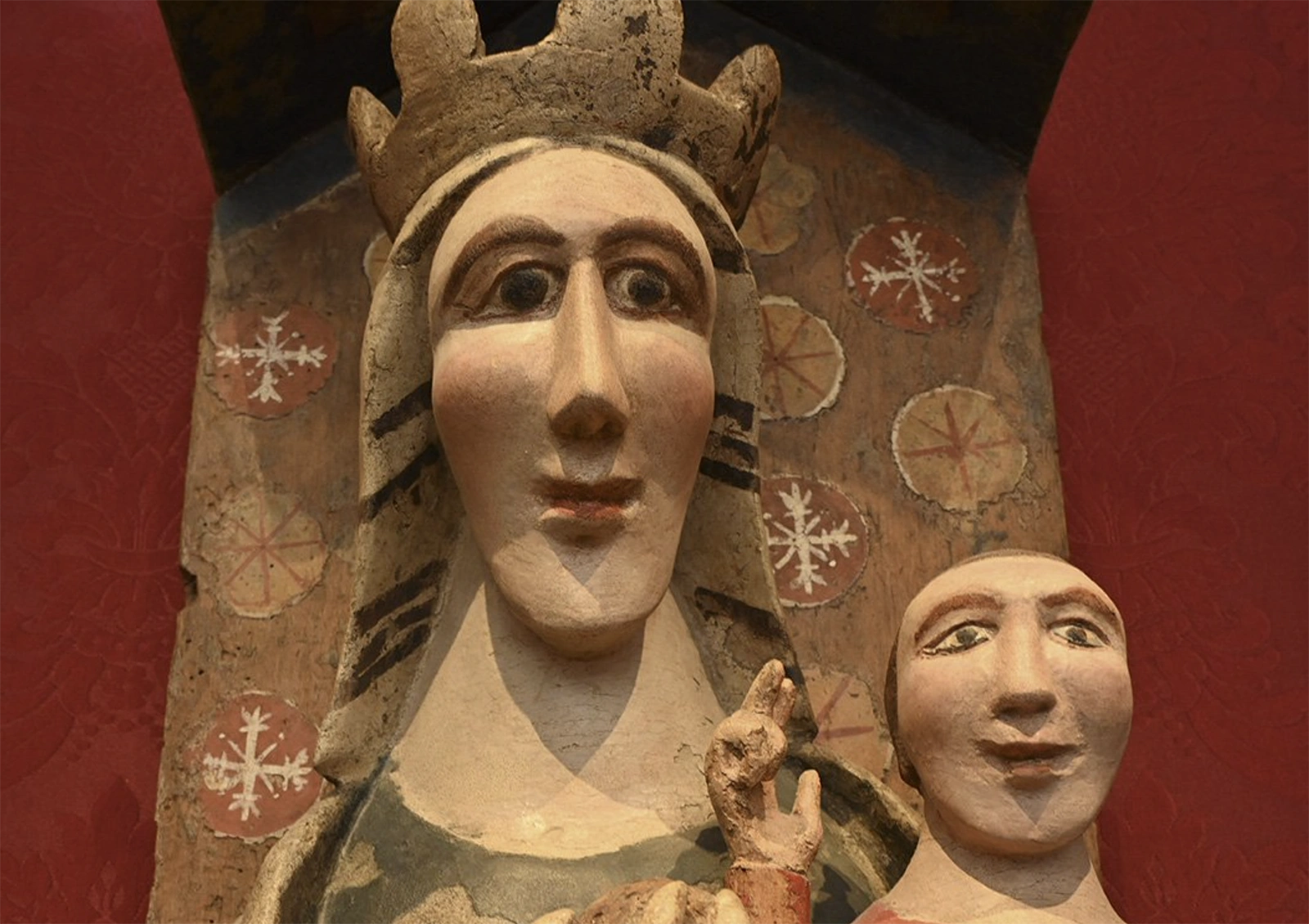
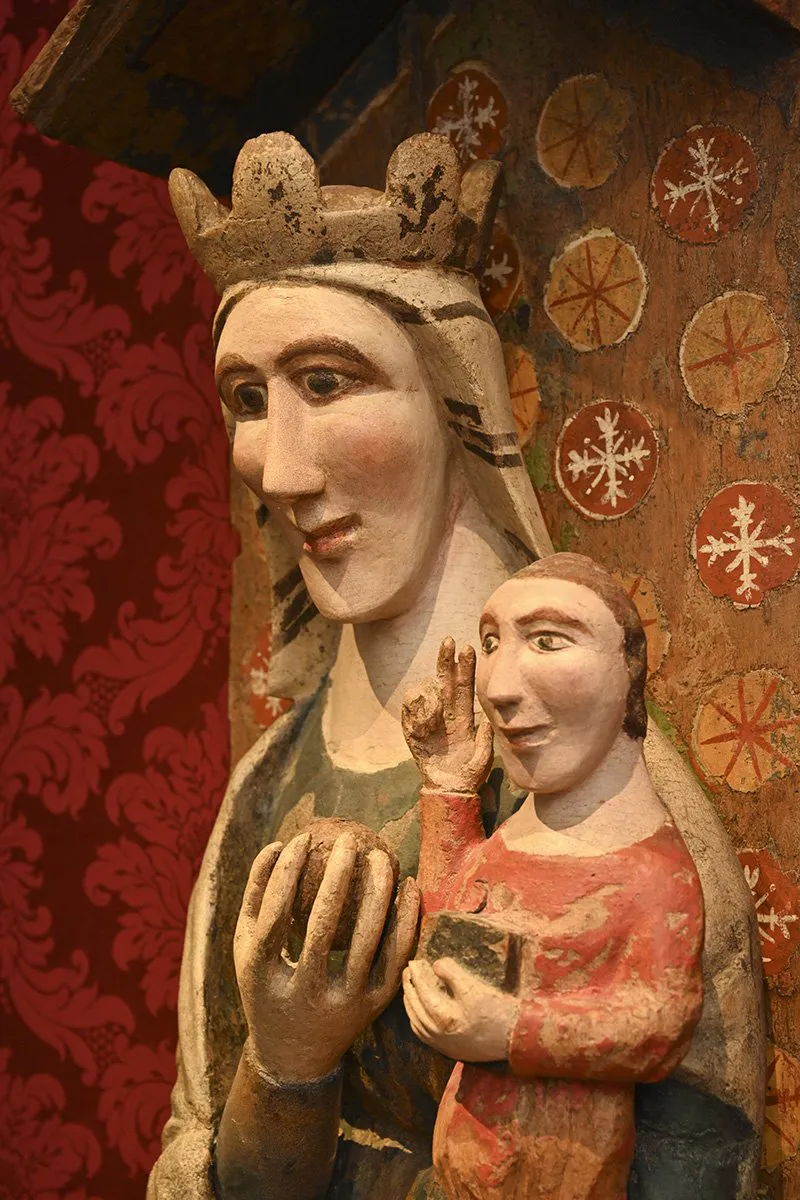
Originally part of a tabernacle that could be closed with painted doors, now lost, the Madonna and Child at the National Museum of Castel Sant’Angelo is depicted seated on a throne in a hieratic, frontal position, while in her left arm she supports the blessing Child. The work, dating to around the mid-14th century, was created by an artist from the Umbria-Abruzzo area and is characterized by a marked expressionism of the facial features, undoubtedly the result of a late-13th-century legacy. During the 15th century, the original faces were covered with actual papier-mâché masks, covered in canvas and painted, and displayed to the public in a display case. These masks were likely created as an update of the faces of the portrayed subjects, responding to the need for stylistic adaptation and contemporary taste and concealing the almost caricatural taste of the physiognomies, close to the Umbrian artistic milieu of the first half of the 14th century. The faces of the Madonna and Child were freed from the two masks only following a restoration project conducted by the Central Institute for Restoration in 1987. The uniqueness of the masks lay precisely in the desire to alter the original expressiveness of the faces to which they were applied.
“This initiative,” stated Massimo Osanna, Director General of the National Museum System, “represents a virtuous example of how the National Museum System fosters dialogue between institutions, local areas, and communities. Promoting works within their context not only strengthens the connection between heritage and local identity, but also fosters new forms of storytelling and knowledge. The deposit of the Madonna and Child at MuNDA is part of a broader strategy aimed at transcending the physical confines of museums to make them increasingly networked spaces, accessible, connected, and open to the local community.”
Of the original structure of the aedicule, only the cusped reredos, adorned with painted crossed circles, and the platform decorated with trefoil arches alternating with trefoil tracery, remain. Conceived more as a relief panel than as a true sculpture in the round, the statue falls within the tradition of depictions of the Virgin enthroned with the Child in her arms, placed within aedicules and intended for altar decoration. It is therefore identifiable as the “casket of Mary,” a Madonna and Child in Majesty. This type of carved and painted wooden artefact is typical of central Italian art, and was particularly popular and widespread in Abruzzo in the Middle Ages, likely due to the presence of workshops specializing in all phases of their production, from carving to painted decoration.
“This work, due to its value, iconography, and stylistic peculiarities,” states Dr. Luca Mercuri, Interim Director of the Pantheon and Castel Sant’Angelo – Directorate of National Museums of the City of Rome, “reveals a specific artistic and cultural climate in central Italy between the 13th and 14th centuries. The collaboration with MuNDA allows it to be fully appreciated, reintroducing it into a regional context that amplifies its meaning and fosters a deeper understanding. This joint initiative between museums reflects the spirit of the National Museum System, strengthening the dialogue between the works and the regions from which they originate, within a shared and deeply rooted narrative.”
The sculpture, which was purchased by the National Museum of Castel Sant’Angelo in 1928 from the archpriest of the small town of Nespolo Sabino, a municipality on the southern outskirts of the province of Rieti, bordering the province of L’Aquila, and displayed in the Chapel of Leo X, presents many affinities with sculptures of the same type held in the collection of the National Museum of Abruzzo, tangible evidence of a period of great artistic fervor in the region between the 12th and 14th centuries. Among these, the most significant relationships are found in particular with the wooden Madonna and Child from the Church of Santa Maria di Picenze (AQ), now housed in the exhibition itinerary of the National Museum of Abruzzo, and also with the wooden examples from the Church of Sant’Agostino di Penne (PE) and the Town Hall of Pizzoli (AQ), all attributable to a period ranging from the mid-13th to the mid-14th century.
These works, characterized by a surprising expressive intensity, reflect the profound connection between Marian devotion and local traditions, often intertwined with ancient pagan fertility cults. The wooden Madonnas from Abruzzo represent the iconography of sedes sapientiae, that is, the Virgin enthroned with the blessing Child. Their exhibition allows us to rediscover not only the artistic refinement of these masterpieces, but also their theological and cultural significance, which played a crucial role in the religious and social life of Abruzzo’s communities.
“We continue to expand our collections through collaboration with other MIC museums, with a view to fully sharing institutional objectives and goals, consisting of the full achievement of the primary functions constituted by the pillars of conservation, research, communication, and education,” concludes Dr. Federica Zalabra, Director of the National Museum of Abruzzo in L’Aquila.