Thus, in his book “The Castle,” around 1922, Kafka portrays it as a colossal, mysterious figure looming over a village, menacing, our sign ad reprimendam audaciam aquilanorum, a metaphor for the eternal condition of human existence, a place of solitude where the conflicts of everyday life unfold, oppressors and oppressed, the writings left by prisoners in the Calabozo of the 16th-century castle, the deconstruction of being.
A place of countermines, prisons, rediscovered mummies, defensive routes, double earlobes, but not only that, also treasures.
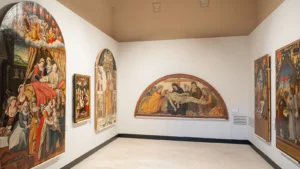
Thus, in 1951, the Spanish Fort, restored from the ravages of Nazi occupation, war still war, became something else. A President of the Italian Republic, Luigi Einaudi, the images show us, driving through the city, transformed that symbol of strength and oppression into inclusion. A museum, the National Museum of Abruzzo, the most important in the region, where, like tributaries of a river, the works of the Civic Museum of L’Aquila and the Diocesan Museum of Sacred Art converged.
This is how the Castle has been described by our officials, including the Masbedo brothers, Nicolò Massazza (b. 1973) and Iacopo Bedogni (b. 1970), recognized among the most important video artists and innovators in the field of contemporary art who use the language of video in their installations in various forms, performance, theater, and photography.
“The project,” comments MuNDA Director Maria Grazia Filetici, “was born from the desire to give voice to a place dear to the city, the Castle, in view of its long-awaited reopening. We are happy to offer moments of participation in the Museum’s upcoming return to the Forte Spagnolo.”
The occasion was the partnership with MAXXI for the International Festival of Performance Art, Dance, Theater, and Music PERFORMATIVE.01 Contact(Less).
The video and audio elements of the performance on the Renaissance defensive routes of the Spanish Fort, with the poignant title “The Eyes of the Mouse,” will narrate, with images shot inside the Castle and an immersive installation, the underground, labyrinthine world where the only outlets to the outside and internal communication are slits in the building’s walls. A place where the auditory aspect prevails, evoking the imagination of those who lived and lost themselves in the Castle, reflecting on the power of sound reinterpreted by Masbedo together with musicians Davide Tomat and Gup Alcaro.
The site-specific audiovisual installation will engage the audience with a projection on the external walls of the Fortress, evoking its routes, underground spaces, silences, and stories.
Walls, therefore, no longer barriers but openings in the future vision of the National Museum of Abruzzo to include, dialogue, interact and create a network with the territory.