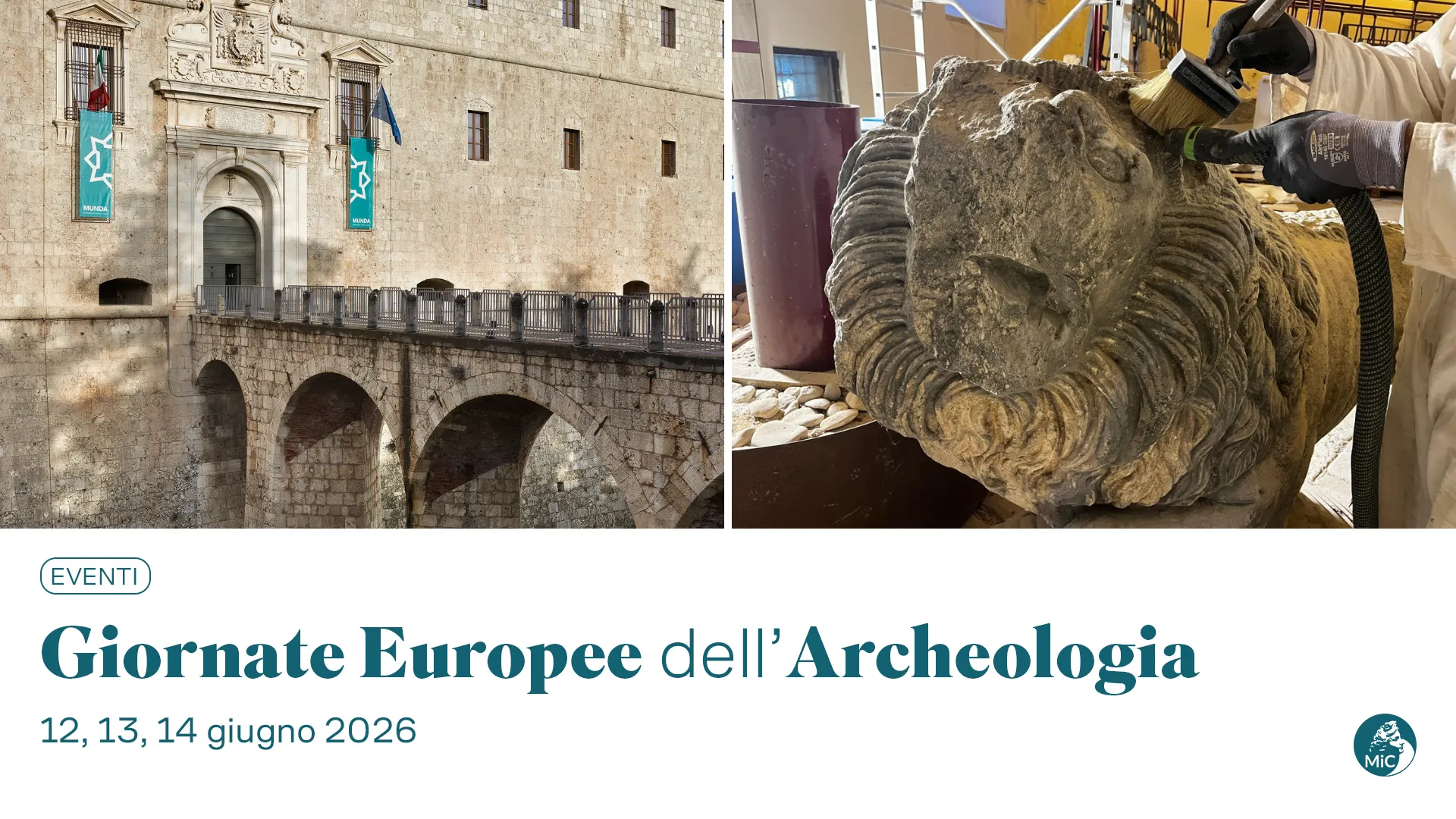

The Ministry of Culture, with its Directorate-General for Museums and Directorate-General for Archaeology, Fine Arts, and Landscape, is once again participating in the European Archaeological Days (GEA), scheduled for June 12-14, 2026, with various initiatives throughout the country to raise public and community awareness of the protection and promotion of the national archaeological heritage.
The National Museum of Abruzzo, which acquired the Amiternum Archaeological Park in July 2024, participates in the GEA by organizing cultural events of an informative and educational nature.
On June 12, at 10:00 a.m., the new temporary reorganization of the southern bastion was presented at a press conference, during the first of three European Archaeological Days, during which the Museum guarantees the widest possible access to its collections and exhibition spaces related to the disciplines of archaeology and paleontology.
Starting in December 2024, the National Museum of Abruzzo has launched a new planned conservation program for the stone artefacts housed in the South Bastion of the Castello cinquecentesco of L’Aquila.
This initiative is part of a broader program to protect and enhance the museum’s collections and involves a series of operations aimed at preventing biodeterioration and improving the artifacts’ condition.
Specifically, the restorers commissioned by the National Museum of Abruzzo were engaged in the application of specific, minimally invasive biocidal treatments, essential for combating the proliferation of microorganisms and ensuring the long-term preservation of the stone surfaces.
The intervention constituted an important preparatory phase for a more comprehensive conservation project that will encompass the entire archaeological collection.
The National Museum of Abruzzo has chosen to adopt a management model that is increasingly central to its cultural heritage protection policies, as it allows for the prevention of deterioration through periodic and targeted activities, reducing the need for more invasive restorations.
In parallel with the conservation operations, a reorganization of the storage and work spaces in the South Bastion was initiated, with the aim of improving collection management and ensuring optimal conditions for future study, movement, and restoration activities.
On the occasion of the European Archaeology Days, the Museum will offer the public the opportunity to experience this important work “behind the scenes” through three days of special openings of the restoration site, scheduled for June 12, 13, and 14.
Visitors will be able to access the spaces of the South Bastion, accompanied by museum staff, who will illustrate the methodologies adopted and the importance of scheduled maintenance for the preservation of cultural heritage.
During the European Archaeology Days, free guided tours will be available, with admission subject to the current fee. Tours will be conducted by Museum archaeologists on June 12th at 3:00 PM; on June 13th and 14th at 10:30 AM and 12:00 PM; and in the afternoon at 3:30 PM and 5:00 PM.
Guided tours, for which reservations are not required, will be open until capacity is reached, with a maximum of 20 people per group.
The GEA initiative is coordinated by the French National Institute for Preventive Archaeological Research (INRAP) under the aegis of the French Ministry of Culture and with the patronage of the Council of Europe.
In 2019, the JNA (National Archaeological Days) opened their doors to Europe, and since 2020, the National Archaeological Days have been renamed the European Archaeological Days (JEA).