
Today, January 31st, at 3:45 PM, at the Opificio delle Pietre Dure in Florence, located at the Fortezza da Basso on Viale Filippo Strozzi 1, ABI President Antonio Patuelli met with the Superintendent of the Opificio, Emanuela Daffra, and the Director of the MuNDA – National Museum of Abruzzo in L’Aquila, Federica Zalabra.
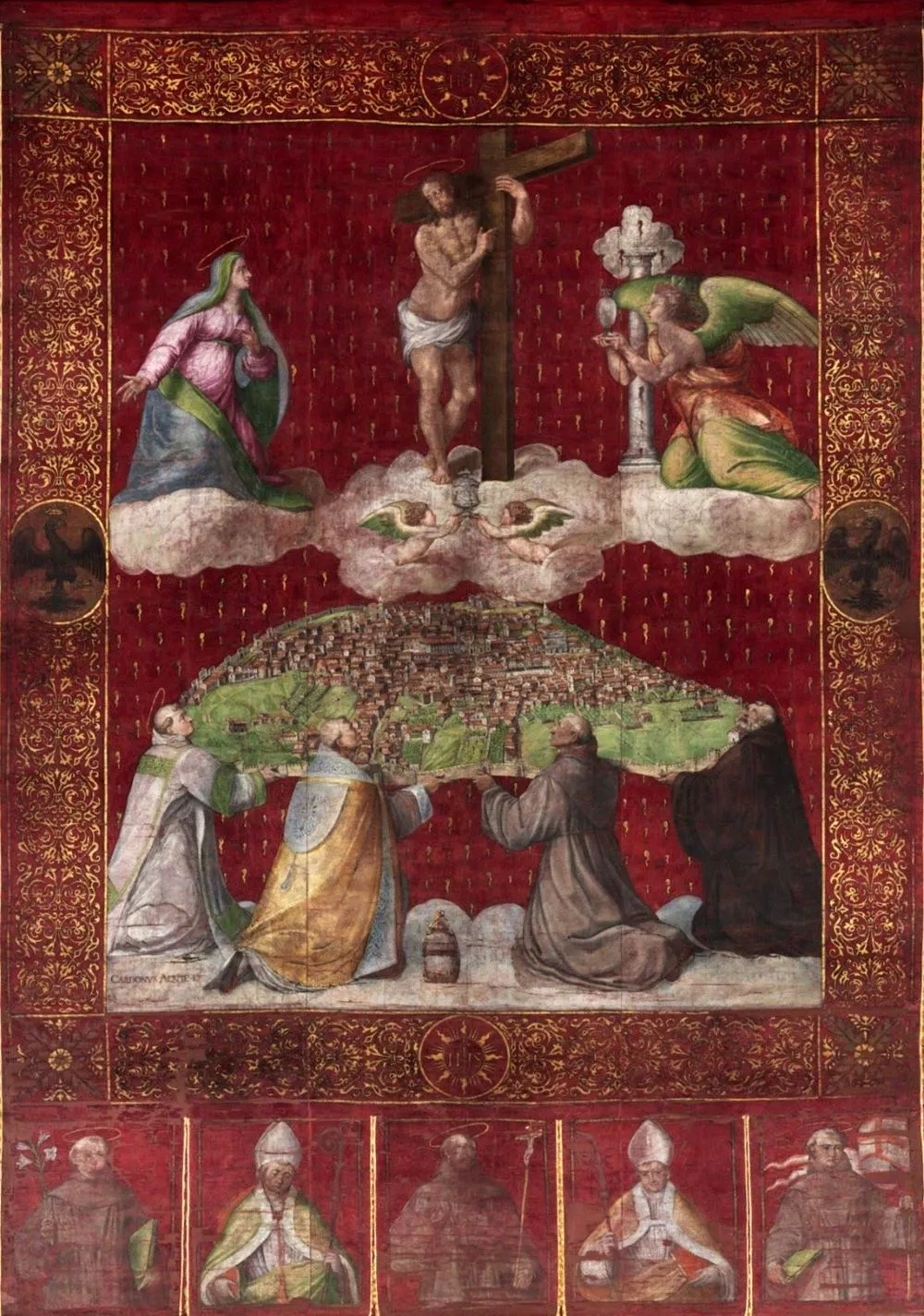
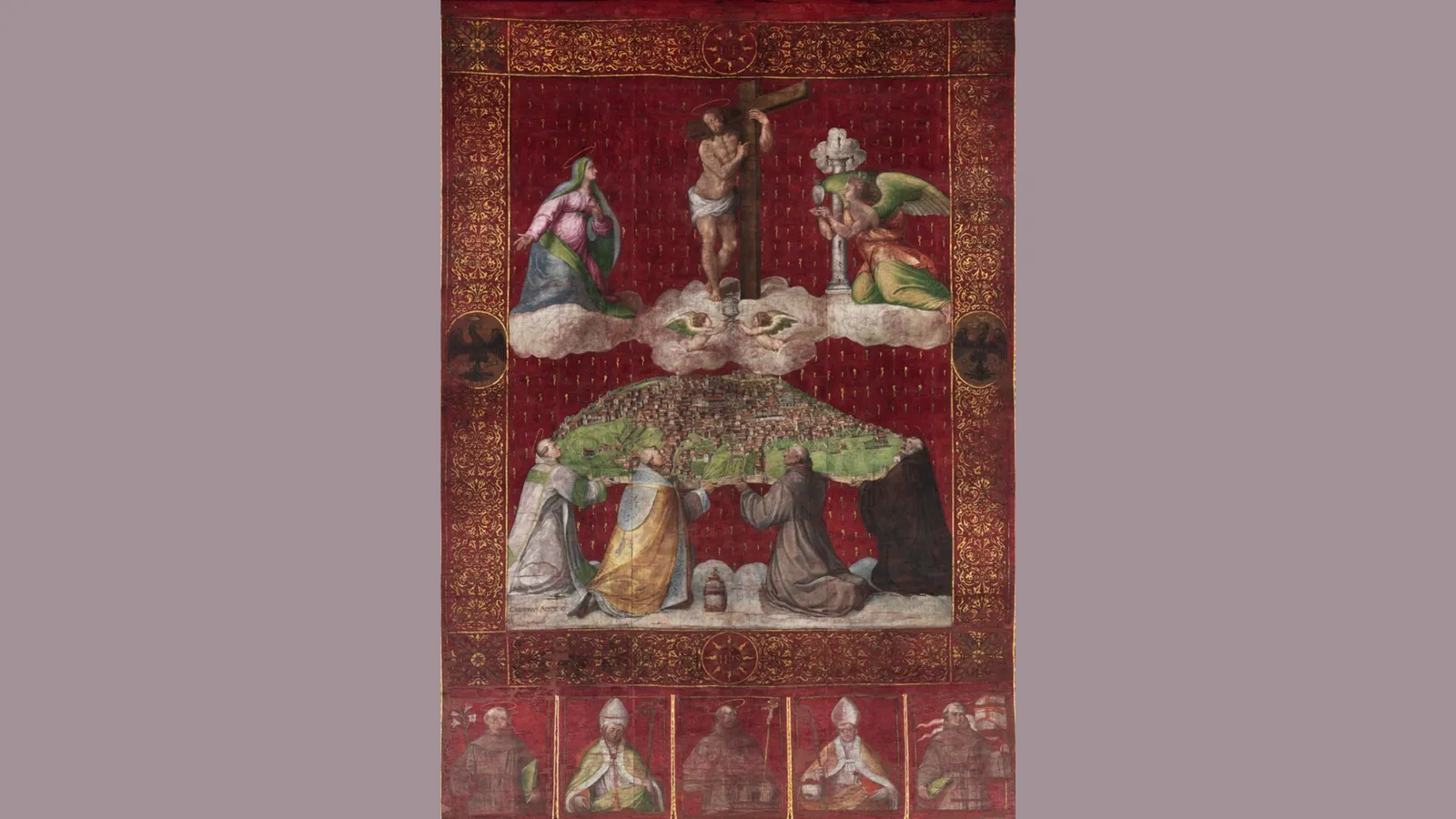
Sixteen years after the 2009 earthquake that struck L’Aquila and Abruzzo, the monumental Gonfalon depicting the city’s patron saints, a 16th-century work by Giovanni Paolo Cardone, now part of the MuNDA – National Museum of Abruzzo in L’Aquila, returns home after undergoing a complex restoration project carried out by technicians from the Florentine Opificio delle Pietre Dure.
The restoration was funded by the Italian Banking Association (ABI) and the banks of the Association’s Cultural Relations Working Group, reflecting the banking world’s contribution to culture, including through the “è cultura!” project.
The presentation of the restored work in Florence, commissioned prior to its return to L’Aquila, was attended by Emanuela Daffra, Superintendent of the Opificio, and Federica Zalabra, Director of the MuNDA – National Museum of Abruzzo in L’Aquila; Antonio Patuelli, President of the Italian Banking Association; and Eugenio Giani, President of the Tuscany Region.
A work with multiple civil and religious meanings, the grandiose Gonfalone, painted in red silk and painted in oil, was created between 1578 and 1579 to replace an earlier example donated by the city of L’Aquila to St. Peter’s Basilica in Rome for the Jubilee of 1575. The prestigious commission was entrusted to the L’Aquila painter Giovan Paolo Cardone, one of the most important artistic figures of late Mannerism in Abruzzo.
The artist, adhering to the precise instructions of the city magistrates regarding a faithful perspective representation of the city, depicted the Virgin prostrate before Christ and Saints Massimo, Pietro Celestino, Bernardino, and Equizio, protectors of L’Aquila. Mirroring the figure of the Virgin Mary is an angel with a chrism ampoule, flanked by the column of the flagellation. At Christ’s feet, two cherubs hold a pyx, a clear reference to the consecrated host. The entire red background appears dotted with small golden flames, alluding to the Holy Spirit, falling in an orderly rhythm over the city. The central scene is framed by a richly decorated frame with gold friezes, interrupted on the longer sides by medallions featuring the black eagle of the city coat of arms and on the shorter sides by the Bernardine trigram within a sun shining with rays. Completing the work, at the bottom, are five rectangular pendants or “drappelle” depicting alternating Saint Anthony of Padua, Saint Francis of Assisi, Saint John of Capistrano, and holy bishops.
The work is striking not only for its artistic quality but also for its size: approximately 15 square meters (460 x 323 cm). For centuries, it was kept in the Basilica of San Bernardino and until 1815, on August 10th, it was carried in procession through the streets of L’Aquila to implore “the serenity of the air.” From the Basilica, it was moved to the Castello cinquecentesco, where it was struck by the 2009 earthquake. Recovered, it remained at the Paludi Museum in Celano until 2013, when, thanks to funding from the Italian Banking Association (ABI), it was entrusted to the Opificio delle Pietre Dure in Florence for restoration, which was completed in 2015.
“The Italian Banking Association,” said ABI President Antonio Patuelli, “is proud to have contributed to the restoration of the Gonfalone dell’Aquila. This important project demonstrates the strength of collaboration for the preservation and protection of our artistic, historical, and cultural heritage. The restoration, supported by the banks and overseen by the Opificio delle Pietre Dure in Florence, represents an example of Italian excellence in the protection of cultural heritage.”
First, the Gonfalone was carefully cleaned of the materials that time and the earthquake had deposited on its fragile surface, before proceeding with detailed documentation, study, and mapping. The first phase involved cleaning, while the second phase of the intervention focused on consolidating and re-adhering the loose textiles.
This complex and detailed operation was preceded by a series of preliminary tests using new adhesive materials, tested for tensile strength.
Finally, the existing lining was removed from the Gonfalone’s seam to avoid further strain on the original structure.
Emanuela Daffra, Superintendent of the Opificio delle Pietre Dure: “For years, the Opificio delle Pietre Dure has been working on the front lines for works damaged by natural disasters, with the aim of preserving, restoring, and returning them to their communities.
In such cases, the challenges are manifold: challenges regarding the intervention itself, certainly, but also regarding the return to settings that have been scarred and transformed. Concerted, synergistic action among diverse stakeholders—bringing together expertise in restoration and the enhancement of museum heritage with private support—is key to overcoming these obstacles. The story of the monumental yet fragile *Gonfalone dell’Aquila* (L’Aquila’s ceremonial banner) serves as a perfect example.”
Federica Zalabra, Director of MuNDA (National Museum of Abruzzo in L’Aquila): “Ahead of the upcoming opening of the National Museum of Abruzzo at the Castello cinquecentesco, we wanted to bring the *Gonfalone* back home. We cannot display it exactly as planned, as the wing intended for its permanent exhibition has not yet been handed back to us; however, we will set up a temporary room where small groups of visitors can admire the work—enhanced by new technological solutions—and finally reclaim a piece of our heritage, especially in light of L’Aquila’s designation as Capital of Culture.”