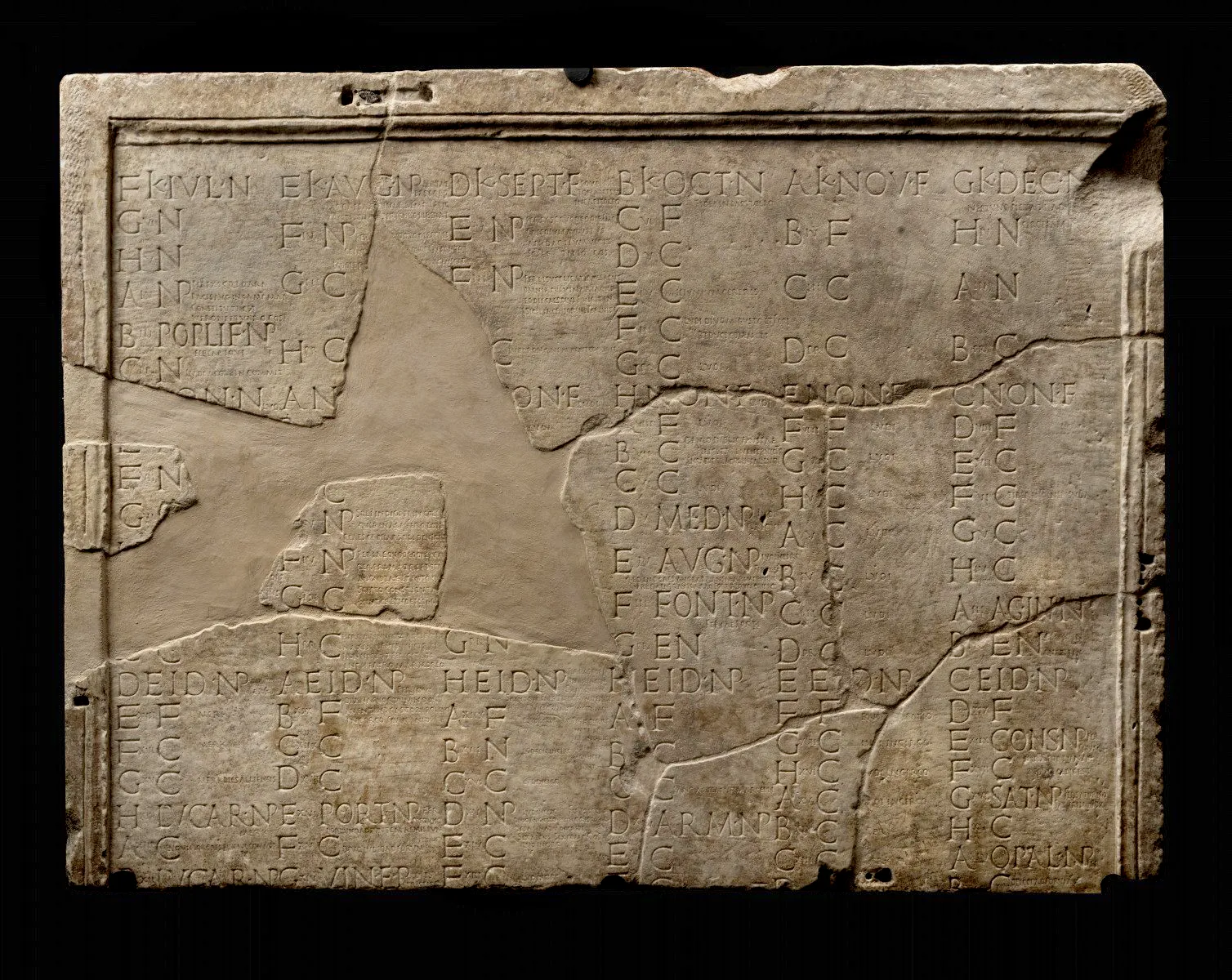
The exhibition, held in the archaeological section of the National Museum of Abruzzo on Via Tancredi da Pentima, aims to highlight one of the most important epigraphic monuments discovered in Abruzzo: the Amiternum calendar.
To this end, we decided to present a reconstruction that offers the public the first glimpse of its appearance and dimensions when, like other calendars, it was displayed in one of the most important public spaces in Amiternum.
Originally composed of two marble panels, the calendar was intended to offer an educational reading by highlighting and explaining the system of time division and the significance of each day within the month.
The calendar is accompanied by two busts representing the Emperor Tiberius (42 BC-37 AD) and his son Drusus Minor (14 BC-23 AD), exquisite portraits from the first half of the 1st century AD, from the National Roman Museum at Palazzo Massimo.
The choice to display the portraits of these two figures is primarily justified by the calendar itself, which dates to the Tiberian era, specifically to 20 AD, the year in which Drusus Minor triumphed over the Balkan region of Illyria, as recorded on May 26 in the smallest fragment from the MuNDA archives.
The exhibition concludes with a small but highly significant fragment of the consular fasti, the chronological list of incumbent magistrates that often accompanied calendars, as was likely the case at Amiternum. Discovered at San Vittorino and preserved in the MuNDA archives, it commemorates the Battle of Actium, one of the most important events in Octavian’s conquest of the principate.