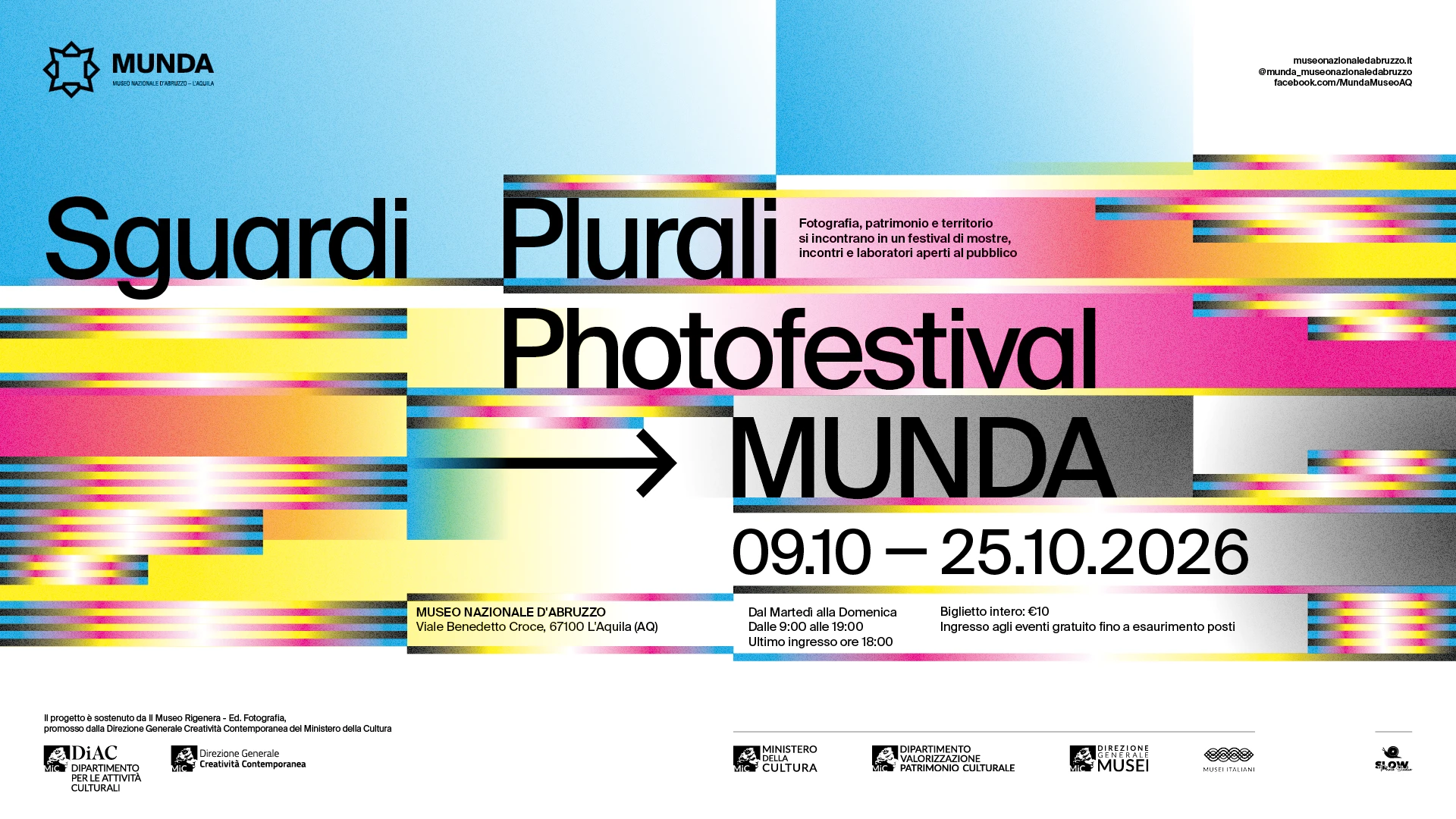

Supported by Il Museo rigenera – Ed. Fotografia—an initiative promoted by the Ministry of Culture’s Directorate-General for Contemporary Creativity—the project transforms MUNDA into a community laboratory from October 9 to 25, 2026.
From October 9 to 25, 2026, the National Museum of Abruzzo (MUNDA) will host the final phase of the project “Sguardi Plurali. Participatory photography practices for the regeneration of the suburbs” —a festival dedicated to analog photography. Centered on the territories, schools, and group homes of the L’Aquila area, the project is supported by Il Museo Rigenera – Ed. Fotografia and promoted by the Ministry of Culture’s Directorate-General for Contemporary Creativity. It aims to foster culture-led urban regeneration initiatives through the photographic documentation of peripheral areas by state museums and cultural sites, actively involving local communities.
The official opening will take place on Friday, October 9, at 11:00 AM.
The “Sguardi Plurali” Festival, which aims to promote dialogue between analog photography, cultural heritage, and the peripheries, transforming the MUNDA venues into places of encounter, research, experimentation, and reconnection between the city center and urban and suburban areas, has been offering a rich and varied program of analog photography workshops, photography outings, meetings with photographers, and exhibitions for five months, starting in July. These will be complemented by events, conferences, and workshops, with a particular focus on engaging local communities, schools, and foster homes.
Through workshops, photography tours, participatory activities, seminars, and a concluding 17-day festival, the project aims to address the relationship between the city center and the peripheries, recognizing cultural heritage as a shared resource and the museum as a place dedicated to the production of knowledge, active citizenship, and urban regeneration, creating a physical and symbolic bridge between the city center and marginalized areas. This project’s purpose is intrinsically linked to the very needs of the National Museum of Abruzzo, which has a dual structure: the 16th-century Castle in the historic center of L’Aquila and the Amiternum Archaeological Park in a peripheral context, making the Museum a place dedicated to connecting the center and the periphery.
Project activities have been carried out in collaboration with the Slow Photo association, which devised three types of workshops and photographic trails across the local area—currently underway—as well as photography workshops in group homes (concluded in August), visual literacy workshops to be launched in schools, and a concluding festival. Scheduled for October 9–25, the festival will feature meetings, seminars, and temporary exhibitions designed to foster dialogue and connect artists with distinct stylistic approaches who share a common commitment to researching participatory photographic practices for the regeneration of the suburbs.
Workshops and projects
From September 4 to 19, a project centered on Camera Stenopeica abitabile by photographers Sergio Maritato and Giampiero Duronio—was carried out over the course of seven sessions.
Designed as an immersive, participatory installation, it allowed participants to physically step inside a pinhole camera, transforming the act of photography into a collective experience of observation and direct experimentation with the photographic process. The images were created using pinhole photography—a lensless technique in which a tiny aperture admits light, projecting an inverted image of the subject into the chamber.
Special emphasis was placed on the relationship between the photographic apparatus, the National Museum of Abruzzo’s heritage, and the local area. The goal was to produce images capturing sites and artifacts central to the project, such as the Amiternum Archaeological Park (an outlying site of the Museum) and the Mammoth housed at the Museum (which originated from a municipality bordering L’Aquila). The project resulted in the creation of four unique pinhole photographs—produced as negatives—depicting key locations within the Amiternum Archaeological Park and the Museum, including the Mammoth skeleton.
Launched on September 18 and concluding on October 4, the participatory photography and shared visual storytelling workshop—titled Percorsi Fotografici —centers on the art of composition and the construction of a visual project. It covers the history of photography, the use of analog cameras, fieldwork and the interpretation of historic sites, and the entire process from film development to the final photographic print. The initiative aims to foster an informed understanding of the local area through photography, linking archaeological heritage, architecture, and landscape with the memory of the places themselves.
The third local workshop— Alternative Processing, dedicated to cyanotype—is scheduled for Saturday, October 10, and Sunday, October 11, coinciding with the final photography festival. Led by photographer Niccolò Cozzi, the activity will explore analog photographic practices and alternative processes, with a particular focus on experimenting with plant-based photographic emulsions. This initiative expands the project’s experimental nature by linking artistic practice, analog photography, material research, and a commitment to process sustainability.
During July and August, workshops were held for three local group homes with the assistance of volunteers from the Slow Photo APS association. The aim was to enable unaccompanied minors to use photography as a tool for personal expression, social connection, and self-representation, while also fostering a new way of observing and telling the story of the local area. The workshops concluded with guided tours of the museum.
The activity made it possible to experience the museum and photography as accessible tools for participation, extending the project’s reach to contexts that are typically less involved in traditional cultural activities.
Starting October 9, the museum will display a composition of over 80 instant photographs taken by young people from group homes; these images offer a collective reimagining of L’Aquila’s 16th-century castle, seen through the eyes of those who experienced it during the workshop.
The Nomade – Ritratti project has also concluded; this was a traveling photography campaign conducted in the area undergoing transformation and reconstruction following the earthquake, specifically focusing on the vicinity of the Amiternum Archaeological Park on the northwestern outskirts of L’Aquila. An exhibition opening on October 9 will feature portraits by photographers Settimio Benedusi and Guido Stazzoni, telling 12 stories of regeneration as interpreted by the artists. The faces and settings at the Amiternum sites reveal the spirit of the regeneration taking place in the L’Aquila area and the “crater” zone, touching upon social, personal, artistic, and cultural dimensions.
Numerous activities are planned at MUNDA venues, local schools, and the Slow Photo Association headquarters, culminating in a festival dedicated to analog photography. The festival will include exhibitions of work created during the workshops, author meet-and-greets, hands-on workshops, and public events, all aimed at fostering a culture of photography, strengthening the bond between the Museum and the local community, and showcasing the project’s outcomes.
The Activities
Workshops held at schools will vary by age group: for younger students, the focus will be on visual literacy, image creation, building cameras from discarded items (such as cans and shoeboxes), exploring narrative possibilities through photography, and cyanotype workshops using leaves and flowers.
Activities for students aged 14 to 18 will focus on visual literacy, camera use and composition, storytelling, cyanotype workshops, and the creation of a photography project.
Specifically, the program includes:
- the Rigenerazioni (Regenerations) group exhibition, featuring work by internationally and nationally renowned photographers alongside pieces created during the workshops;
- seminars and public events focused on photography and the regeneration of the suburbs;
- opportunities for dialogue among photographers, professionals, students, and local communities.
On October 9, as part of the festival, the group exhibition Rigenerazioni. Persone, luoghi, sguardi will open. In addition to the work produced during the workshops, the exhibition will showcase the projects Spiagge Bianche by Niccolò Cozzi, Scampia Anno Zero by Robbie McIntosh, and A’ croce mia by Serena Salerno. The exhibition is built around a concept that runs through all the project’s works in various forms—regeneration—explored through three lenses: people, places, and perspectives.
People are regenerated through portraiture; places reveal urban and environmental transformations; and the perspectives of workshop participants offer new interpretations of heritage and the local landscape.
At the heart of this initiative is the National Museum of Abruzzo, which—through the Castle and the Amiternum Archaeological Park—connects the city center with the outskirts, and heritage with the community.
Revitalizing a territory means transforming not only its spaces but also the way we view and inhabit them.
A short seminar series titled “The Regeneration of the Outskirts” is also planned; these sessions aim to expand the project’s educational scope and foster dialogue between professionals and the interested public.
- Saturday, October 10 – 1st Seminar: “Social Photography,” led by photographer Robbie McIntosh
- Sunday, October 11 – 2nd Seminar: “Portraiture,” led by photographers Settimio Benedusi and Serena Salerno
The Festival catalog and a full account of the activities will be presented during the Festival’s final week, from October 19 to 25.