To know
About artworks
Share
Title
Date
Dimensions
Origin
Collection
Location
Position
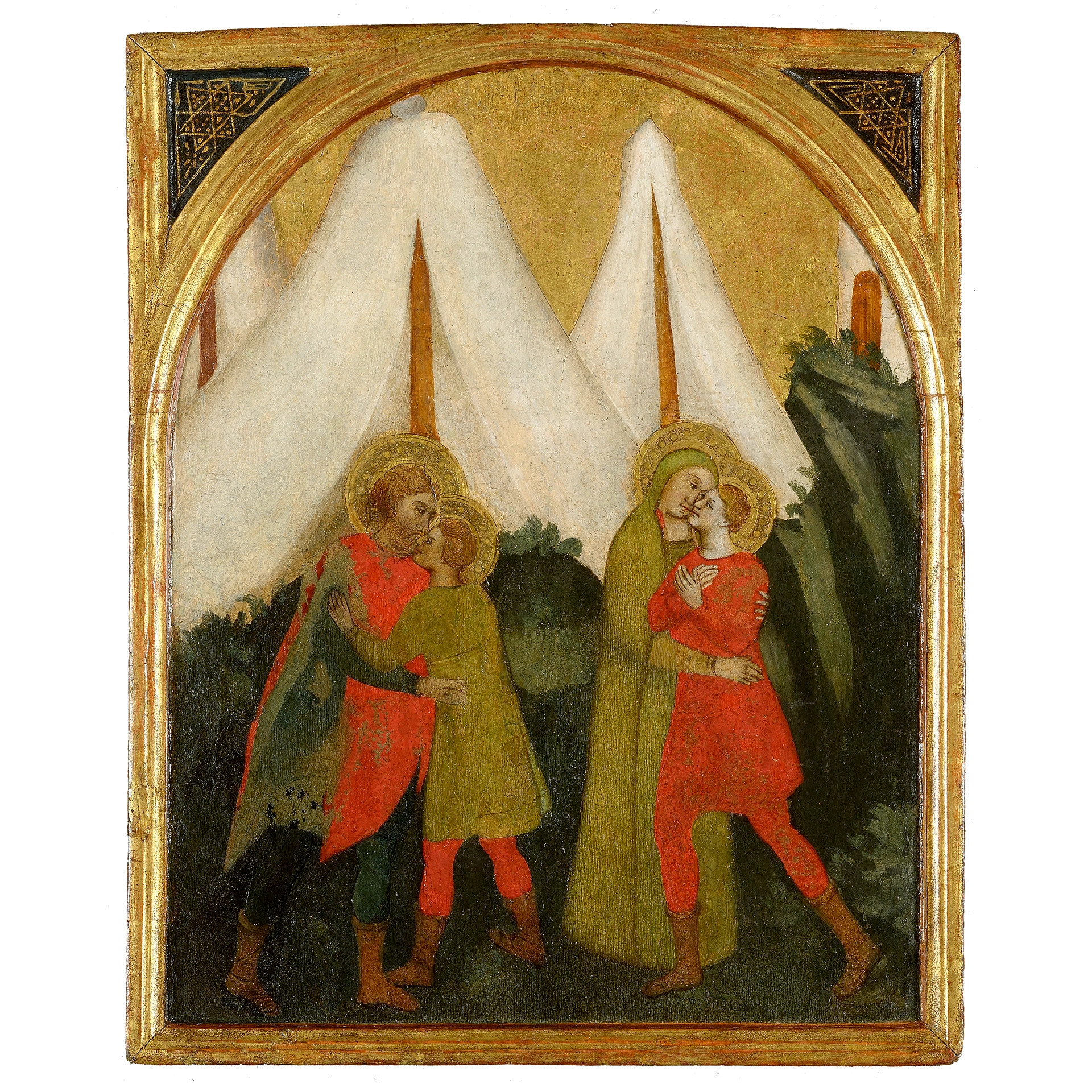
Theopista notices that the story told by Eustace coincides with the one told by the two young soldiers and summons Theopistus and Agapitus before the general. The scene, the first of the fourth register, depicts the moment when the family, after many vicissitudes, is reunited. In the foreground, the two parents, one on the left, the other on the right, are respectively embracing and kissing their grown up sons.
The scene is constructed through the chromatic contrasts between reds and greens that define the clothing of the two groups. The background is occupied by the tents of the encampment and, on the right, by a building placed on top of a rocky landscape, similar to that already depicted in the scene of Eustace finds his wife again.
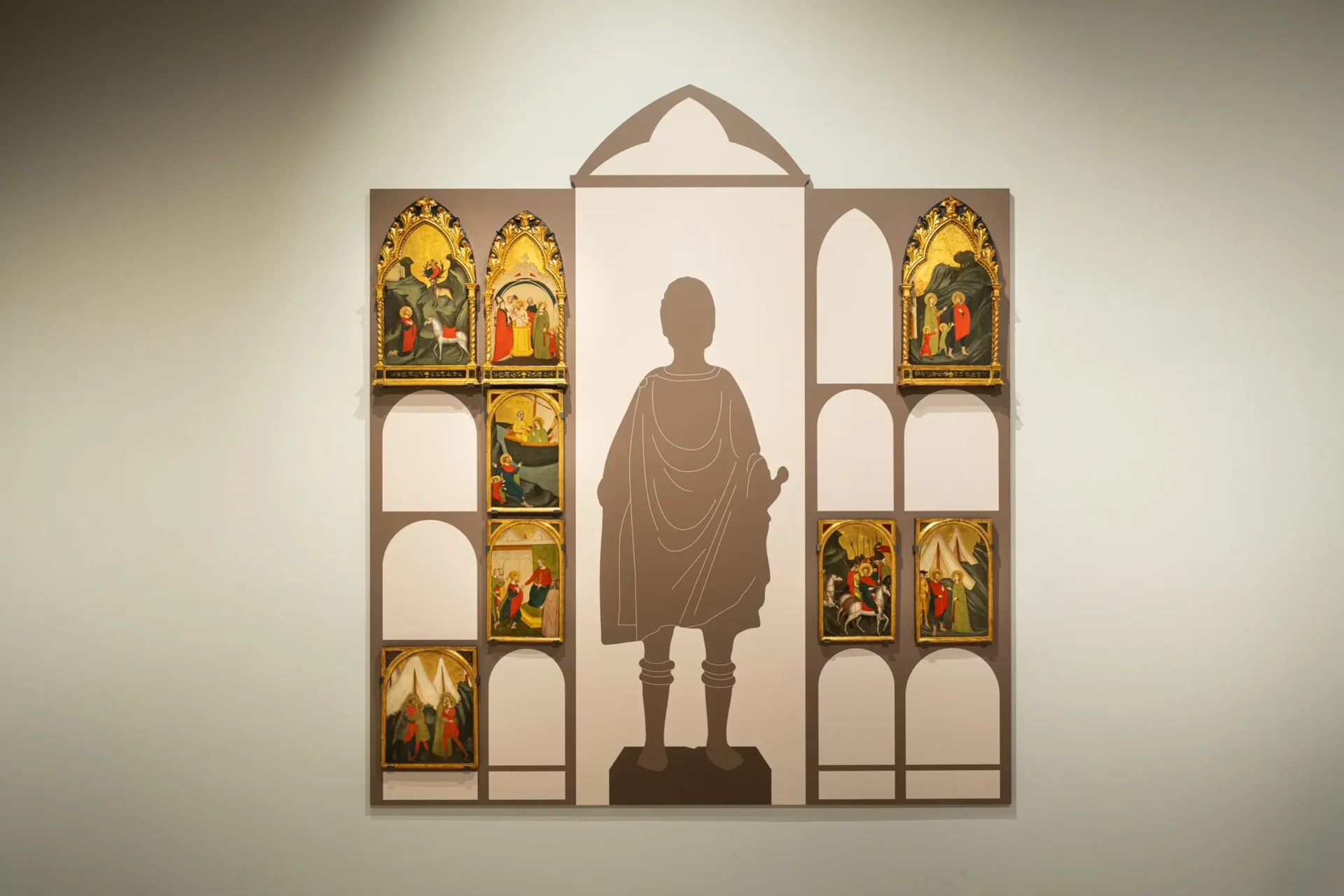
Federico Zeri, then Inspector in Rome, identified and recovered the tablet on the Roman antiquities market, where it had arrived from the Florentine collection of J. P. Gentner. The discovery involved the then Superintendent of L’Acuila Umberto Chierici, but only his successor Raffaello Delogu was responsible for transferring the work to the L’Aquila Superintendence. Since 1954, the work has been part of the collection of the Museo Nazionale d’Abruzzo. These painted panels were originally part of the wooden doors of a tabernacle that held a statue of Saint Eustace, the patron saint of the parish of Campo di Giove (L’Aquila).
Each door was made of two vertical boards with hinges. On the inside, sixteen scenes painted in tempera illustrated key moments in the life of Saint Eustace, from his conversion to his martyrdom, based on the Golden Legend by Jacobus de Voragine. In 1902, the doors were stolen from the church. Later, the panels were cut into individual scenes and sold on the antiques market.
Of these, eight belong to the MuNDA, five are part of a private collection, and three are still missing. The sculpture is kept at the Diocese of Sulmona-Valva.
- A. De Nino, Una pittura rubata a Campodigiove, in “L’arte”, 5, 1902, pp. 425-426.
- P. Piccirilli, Notizie d’arte. Opere d’arte in Campodigiove, in “L’arte”, 6, 1903, pp. 210-217.
- V. Mariani, Sculture lignee in Abruzzo, Istituto Nazionale L.U.C.E., Roma 1930.
- I. C. Gavini, Sommario della storia della scultura in Abruzzo, Nicola de Arcangelis, Casalbordino 1932.
- M. R. Gabbrielli, Plastica lignea abruzzese, in “Rassegna marchigiana”, 1933, pp. 114-123.
- M. R. Gabbrielli, Inventario degli oggetti d’arte d’Italia, IV, Provincia di Aquila, Libreria dello Stato, Roma 1934.
- G. Kaftal, Iconography of the Saint in Tuscany, Sansoni, Firenze 1952, pp. 356-360.
- G. Matthiae, Il Castello dell’Aquila e il Museo Nazionale abruzzese, Istituto Poligrafico dello Stato, Roma 1959.
- M. Moretti, Il Museo nazionale d’Abruzzo nel Castello cinquecentesco dell’Aquila, L. U. Japadre, L’Aquila 1968.
- V. Orsini, Campo di Giove dai primitivi alla seggiovia, Tipografia Labor, Campo di Giove 1970, pp. 183-192.
- M. Moretti, Guida al Castello cinquecentesco o dell’Aquila e al Museo Nazionale d’Abruzzo, L. U. Japadre, L’Aquila 1971.
- M. J. Eisenberg, A late Trecento Custodia with the life of Saint Eustace, in L. Irving (a cura di), Studies in late Medieval and Renaissance paintings in honour of Millard Meiss, I, New York University Press, New York 1977, pp. 147-151.
- M. J. Eisenberg, A late Trecento Custodia with the life of Saint Eustace, in L. Irving (a cura di), Studies in late Medieval and Renaissance paintings in honour of Millard Meiss, II, New York University Press, New York 1977, pp. 47-53.
- L. P. Nicoletti, Il Maestro di Campo di Giove, in G. Agosti (a cura di), Altri quaranta dipinti antichi dalla collezione Alberto Saibene, Edizioni Valdolenga, Verona 2008, pp. 4-25
- C. Pasqualetti (a cura di), Ritorno in Abruzzo: Le storie di S. Eustachio restituite dal Grand Rapids Art Museum, Gruppo Tipografico Editoriale, L’Aquila 2008.
- C. Pasqualetti, scheda opera, in L. F. Porcaroli (a cura di), S.O.S. arte dall’Abruzzo: una mostra per non dimenticare, catalogo della mostra (Museo Nazionale di Castel Sant’Angelo, Roma, 24 aprile-5 settembre 2010), Gangemi, Roma 2010, pp. 173-174.
- S. Paone, Tabernacoli dipinti e scultura lignea in Abruzzo: il maestro di Fossa e il Maestro del Crocifisso d’argento, in “Studi medievali e moderni”, 15, 2011, pp. 45-68.
- A. Delpriori, Il San Nicola di Monticchio e i tabernacoli monumentali come pale d’altare. Considerazioni sulla pittura e sulla scultura del Trecento, in C. Pasqualetti (a cura di), La via degli Abruzzi e le arti del Medioevo (secc. XIII-XV), Onegroup, L’Aquila 2014, pp. 59-74.
- L. P. Nicoletti, Sulle tracce della Custodia di Campo di Giove. Fortuna critica e di mercato dei frammenti delle Storie di Sant’Eustachio, in C. Pasqualetti (a cura di), La via degli Abruzzi e le arti del Medioevo (secc. XIII-XV), One Group, L’Aquila 2014, pp. 75-86.
- C. Pasqualetti, «Nicola Olivieri della Pietranziera pinxit»: ritorno a Campo di Giove, in C. Pasqualetti (a cura di), La Via degli Abruzzi e le arti nel Medioevo (secc. XIII-XV), One Group, L’Aquila 2014, pp. 105-116.
- L. Arbace, M. Congeduti (a cura di), MuNDA, Museo Nazionale d’Abruzzo: storia, testimonianze, restauri, Menabò, Ortona 2020.
C. Pasqualetti, Pittori di confine. Nuove ricerche e scoperte sui trecenteschi ‘umbri’ in Abruzzo, in “Paragone”, s. iii, 149, 2020 (lxxi), pp. 3-20. - C. Pasqualetti, Central Italian “tabernacula”: a survey, in F. Gutièrrez Baños, J. Kroesen, E. Andersen (a cura di), The saint enshrined: European tabernacle-altarpieces, c. 1150-1400, Bellaterra, Cerdanyola de Vallès 2021, pp. 183-230.
Documents
Soprintendenza Archeologia, Belle Arti e Paesaggio per le province di L’Aquila e Teramo, Archivio Storico, b. Campo di Giove, f. Chiesa di Sant’Eustachio.
Archivio Centrale dello Stato, Ministero della Pubblica Istruzione, Direzione Generale Archeologia e Belle Arti, v. III, s. II, b. 250, f. 12.
Fondazione Federico Zeri, Fondo Zeri, s. Pittura italiana, b. 123. Pittura italiana sec. XIV. Umbria, Abruzzi, f. 6. Anonimi abruzzesi sec. IVX (inv. foto inv. 31156, 31158; 31162; 31161; 31163; 31164; 31159, 31166, 31167, 31168, 31169, 31170, 31165).
Fondazione Federico Zeri, Fondo Fototeca Everett Fahy, s. Arte italiana, b. Abruzzi-Avignon, f. 4 – Master of Castelvecchio Subequo C.
Other artworks
Support
If you care about the National Museum of Abruzzo and would like to help protect and enhance its collections, please make a donation.