

To know
About artworks
Title
Date
Dimensions
Origin
Collection
Location
Position
Photo credits
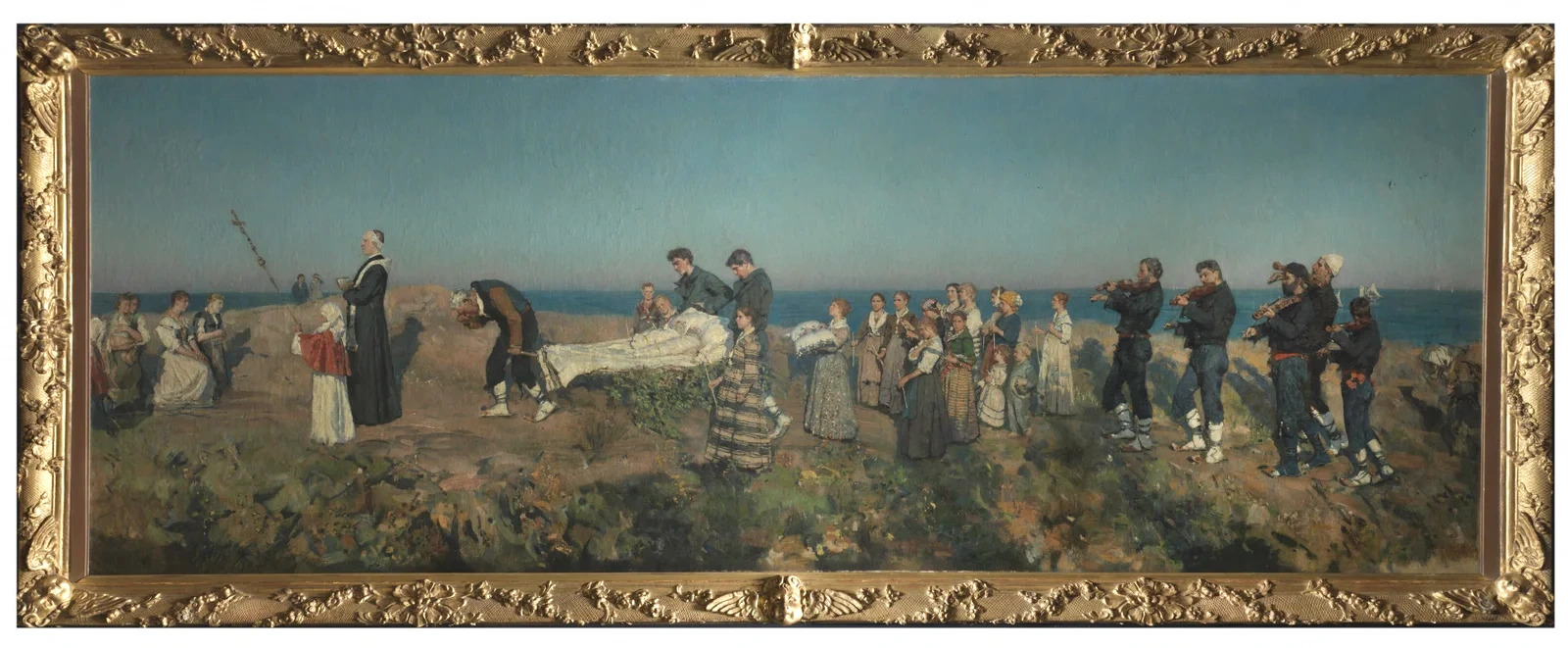
Abandoned the depictions of an idyllic nature populated by playful peasants and shepherds that characterise so much of his early production, Michetti with this painting presents a personal poetic of grief that fuses Christian and pagan aspects into a single vision.
As in a film sequence, in fact, the painting portrays a serene and calm funeral procession for two newborn twins that takes place along a stretch of the Francavilla coastline, involving the spectator in an occurrence felt to be inescapable in the natural cycle of life.
The figures, depicted in the foreground in their traditional costumes and divided into three groups, move slowly against a calm sea and a sky dense with blue and light in the background. The intense emotional participation of the artist, who was at the side of his friend Edoardo Dalbono when the latter lost his young son to diphtheria, shines through.
Some of the pieces are remarkable in their pictorial rendering, such as the black figure of the priest, who stands almost as if he were a monolith between earth and sky in the head group, or the small colourful crowd of women and children accompanying the coffin in the centre, or the group of five violinists in their dark clothes who follow the procession while playing.
Among them can be recognised some of the artist’s closest friends and frequent visitors to Michetti’s cenacle, including the composer Francesco Paolo Tosti who leads the group and, behind him, the sculptor Costantino Barbella. Striking for its modernity, then, is the concise figure of an elderly woman rendered with simple, broad strokes of colour who, on the far right of the painting, as if entering from the frame, follows the procession stooped and slow.
Immediately admired by Camillo Boito for the “stillness of nature” and by Gabriele D’Annunzio for the intensity of the blues, the painting was shown for the first time at the 1880 National Exhibition in Turin, where it was a great success. After the Italian Exhibition in London in 1881, the work ended up on the antiquarian market and entered the collections of the National Museum of Abruzzo only in 2004.
If you care about the National Museum of Abruzzo and would like to help protect and enhance its collections, please make a donation.