
Description
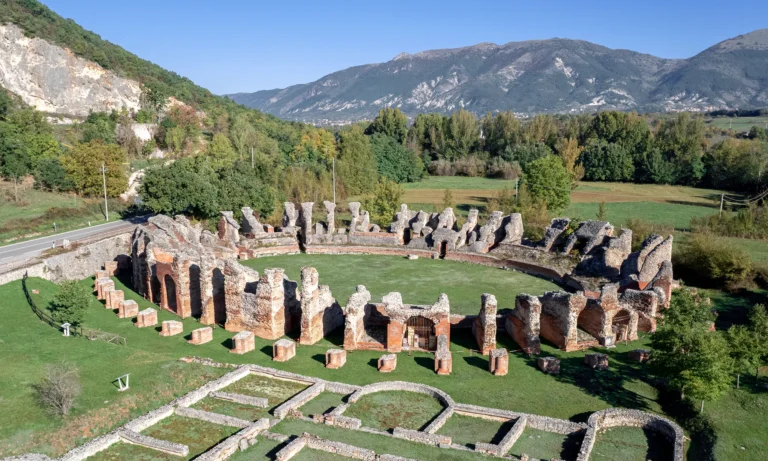
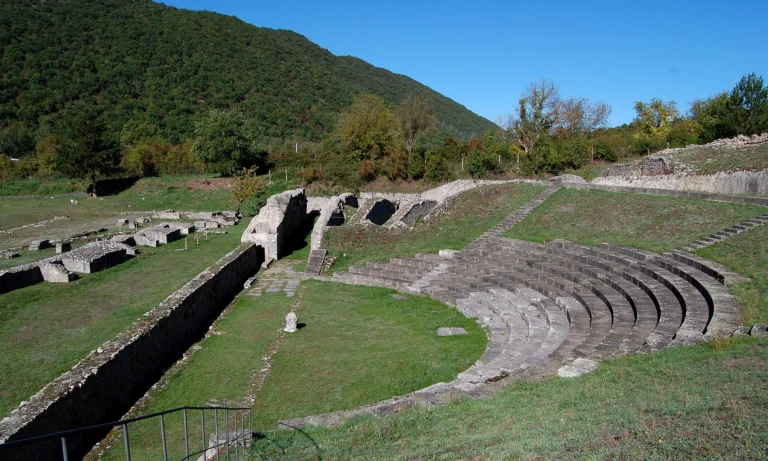
The National Museum of Abruzzo L’Aquila, pursuant to Ministerial Decree 53 of 9 February 2024 Amendments to the Ministerial Decree of 23 December 2014, concerning the “Organization and Operation of State Museums” and Prime Ministerial Decree no. 57 of 15 March 2024, concerning the “Organization Regulations of the Ministry of Culture, the offices directly collaborating with the Minister and the Independent Performance Evaluation Body”, recently acquired the Amiternum Archaeological Park, consisting of the sites of the Theatre and the Amphitheatre with two separate entrances, separated by current roads and the course of the Aterno River.
The area where the site of Amiternum now stands has been inhabited since ancient times, as evidenced by the discovery of traces dating back to the Neolithic. Research conducted near the urban center indicates that, during the Iron Age, this area was inhabited by peoples who lived in fortified villages scattered along the hilltops to control the passes and protect their livestock in times of danger. These people were later called “Sabines” by the Romans. One of the most important Sabine centers corresponded to the present-day village of San Vittorino, southeast of the current archaeological area, which some hypothetically identify with the ancient settlement of Testruna, mentioned in ancient sources.
Recent excavations have confirmed the existence of tombs and buildings dating back to the 7th century BC near the church of San Vittorino, where fragments of a vase bearing a rare graffito written in the ancient Paleosabellian language of the time were also found.
The Amiternum area was anciently considered the starting point of a series of organized migrations (vera sacra) that led, over time, to the occupation of neighboring territories. Following the Roman conquest of the area, perhaps consolidated in 290 BC by the consul Manius Curius Dentatus, the territory of Amiternum was administratively organized in the form of a prefecture (praefectura): each year, in fact, a magistrate was sent from Rome to administer justice (praefectus iure dicundo).
From an urban planning perspective, the city developed along the route of the Via Cecilia (Via Caecilia), around which secondary roads, other infrastructures (such as the aqueduct) and public and private spaces were built.
The main economic activity was livestock farming, favored by the strategic location along transhumance routes, with the herds moving towards southern Italy in the winter and returning in the summer. Agriculture also developed significantly after the arrival of the Romans: Latin sources mention the cultivation of a local grape variety, called pumila in Latin, as well as turnips and Amiternini onions.
The new city underwent further phases of growth and monumentalization, with the construction of the theater first (second half of the 1st century BC) and then the amphitheater (late 1st century AD), as well as temples and other richly decorated buildings. Further embellishment and restoration work is documented throughout the Imperial Age until the 4th century AD.
Beginning in the 5th century AD, dwellings and cemeteries were built on the city’s monuments. In the following centuries, some of the inhabitants settled near the church of Santa Maria in Campo, near the amphitheater.
Amiternum was still inhabited until the 15th century, approximately two centuries after the founding of the city of L’Aquila.