

To know
About artworks
Title
Date
Dimensions
Origin
Collection
Location
Position
The earliest known reference to the painting appears in a handwritten annotation by the scholar Angelo Leosini in his copy of Monumenti storici artistici della città di Aquila e suoi contorni (1848). In a marginal note, he described a small panel depicting the Virgin with the Child on her lap, accompanied by two angels and bearing the inscription «Opus Nicolai de Guardia Grelis». This description corresponds closely to the panel now in the Uffizi, allowing it to be identified with the work seen in L’Aquila in the mid-15th century.
The painting later left the Abruzzo region and reappeared in 1905 at the Mostra d’arte antica abruzzese in Chieti, where it was exhibited by the Florentine art dealer Giuseppe Salvadori. It attracted the attention of the Uffizi director Corrado Ricci, who recommended its acquisition to the Ministry of Public Instruction. The painting entered the Uffizi collections in 1906.
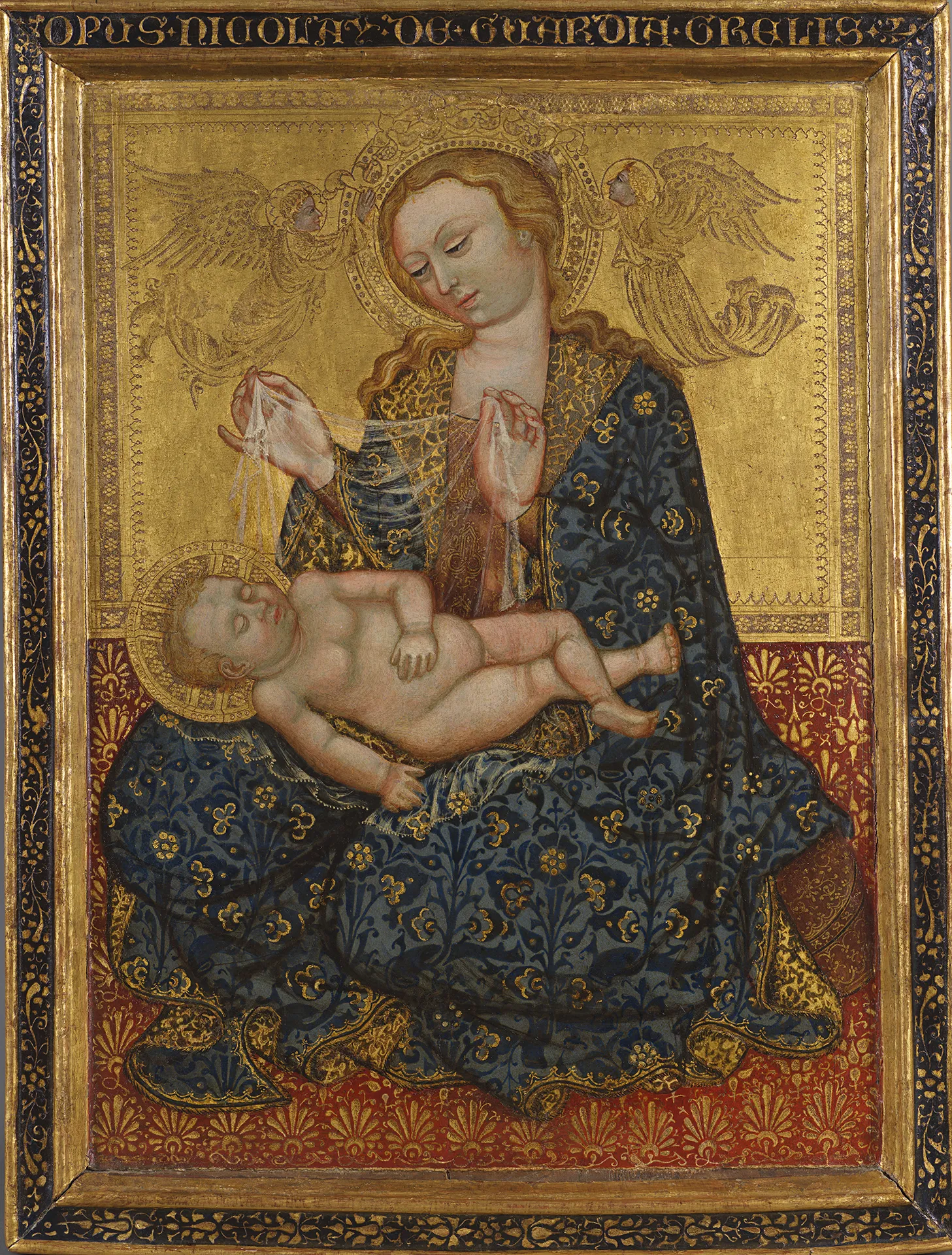
The panel represents the Madonna of Humility, an iconographic type widely diffused in early 15th-century painting. The Virgin sits on a red cushion, wrapped in a blue mantle enriched with delicate gold floral motifs. The sleeping Child rests on her lap, while Mary gently lifts a transparent veil to cover his body – a gesture that symbolically alludes to the future Passion.
Two flying angels crown the Virgin, their bodies rendered through granulated decoration on the gold background. The upper field of the composition is entirely gilded and punched, while the lower part is occupied by a red carpet decorated with stylised vegetal motifs. The panel retains its original wooden frame, adorned with gold floral patterns on a blue ground and bearing the Gothic inscription: «OPUS NICOLAY DE GUARDIA GRELIS».
This painting, the only signed pictorial work by Nicola da Guardiagrele, is crucial for understanding the artist’s multifaceted career, better known for his achievements as a goldsmith. Certain stylistic features, including the modelling of the Child and the solidity of the figures, reveal close connections with his work in metal.
The panel also belongs to the artistic context of early 15th-century Abruzzo and shows affinities with the language of the so-called Master of the Beffi Triptych, particularly in the physiognomy of the Virgin and the decorative treatment of the gold ground.
At the same time, the painting reflects Nicola’s openness to the visual culture of the International Gothic, especially the influence of Gentile da Fabriano. The luminous handling of gold and the motif of angels crowning the Virgin place the work within the broader network of artistic exchanges that linked Abruzzo with the cultural centres of central Italy in the early 15th century.
If you care about the National Museum of Abruzzo and would like to help protect and enhance its collections, please make a donation.