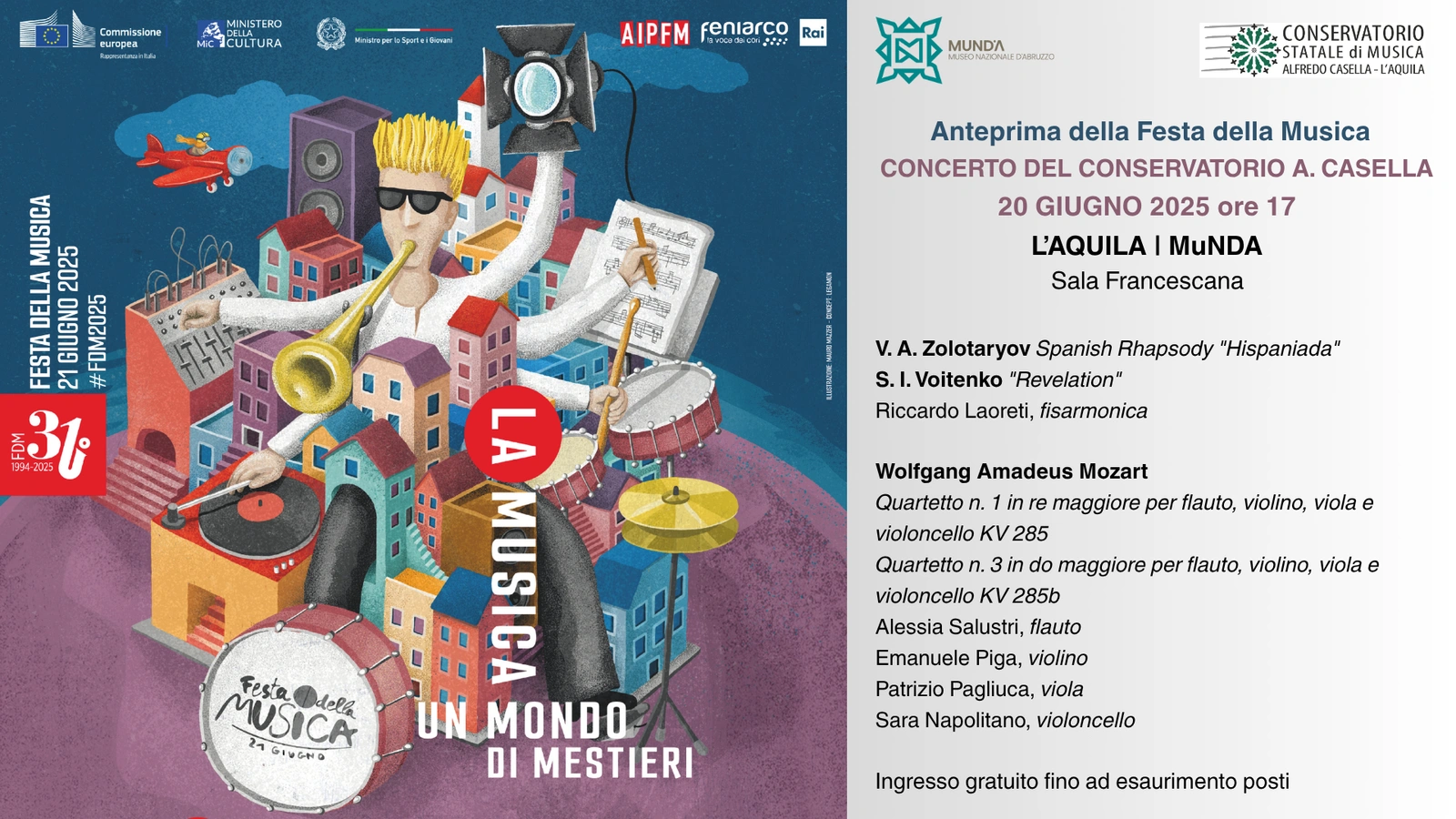

The Fête de la Musique, which takes place annually on June 21, the day of the summer solstice, was established in France on June 21, 1982, as an initiative conceived by the French Ministry of Culture. Its aim was to promote awareness of musical heritage among all audiences through performances by amateur and professional musicians in the streets, courtyards, squares, gardens, stations, and museums.
Since 1985, the European Year of Music, the Fête de la Musique has been held in Europe and around the world. The AIPFM – Italian Association for the Promotion of the Fête de la Musique – coordinates the organizational activities in Italy with the Ministry of Culture and other institutions.
The National Museum of Abruzzo in L’Aquila, in collaboration with the Alfredo Casella State Conservatory of L’Aquila, is also participating in the initiative with a preview of the Fête de la Musique.
The concert, which will be held in the MuNDA’s Sala Francescana on Friday, June 20th at 5:00 PM, will feature students from the Casella Conservatory. With a beautiful program, they will compete on this exceptional day, where all musicians and musical institutions are invited to participate spontaneously.
Program
A. Zolotaryov, Spanish Rhapsody “Hispaniada”
I. Voitenko, “Revelation”
Performer: Riccardo Laoreti, Accordion
Wolfgang Amadeus Mozart (1756–1791)
Quartet No. 1 in D major for flute, violin, viola, and cello, KV 285
Allegro
Adagio
Rondò. Allegretto
Orchestra: flute, violin, viola, cello
Composition: Mannheim, December 25, 1777
Quartet No. 3 in C major for flute, violin, viola, and cello, K. 285b
Allegro
Andantino
Orchestra: flute, violin, viola, cello
Composition: Mannheim, December 25, 1777 – February 14, 1778
Performers
Alessia Salustri, flute
Emanuele Piga, violin
Patrizio Pagliuca, viola
Sara Napolitano, cello
Vladislav Andreyevich Zolotaryov (1942 – 1975) was a Soviet composer and bayanist.
He composed large-scale and chamber works, string quartets, and vocal music, but is best known for his works for bayan (button accordion).
From 1965 onward, the accordion repertoire in the USSR further developed thanks to the works of this young composer, whose music aroused great interest among Russian musicians who were discovering the new possibilities of the multi-timbral free-bass accordion. From this point on, all his new compositions had a new, unexpected, and revolutionary style for the traditional bayan, successfully elevating the instrument from a narrow circle of accordionists to great music.
Sergey Ivanovich Voytenko, born May 12, 1973 in Bogdanovka, is a Russian musician, composer, author, and performer.
Revelation is a contemporary piece characterized by great communicative power and intense emotional contrasts, highlighting the dramatic power of the instrument.
Wolfgang Amadeus Mozart (1756-1791)
Quartet No. 1 in D major for flute, violin, viola, and cello, KV 285
These wonderful quartets for flute and string trio were composed in 1777/78 during Mozart’s first tour without his father. Quartets K. 285 and K. 285b are undoubtedly among the most important works of the genre, characterized by a carefree quality with typical shades of melancholy in the slow movements.
The sparkling Quartet in D major, K. 285, of which an autograph manuscript exists bearing the epigraph of December 25, 1777, represents an absolute masterpiece both for its transcendence of the conventions of galant style and for the quality of its thematic invention, and constitutes a virtuosic outing for all four instruments.
Quartet No. 3 in C major for flute, violin, viola, and cello, K. 285b
The Quartet in C major for flute and strings, K. 285b, of which an autograph manuscript does not exist, is in two movements, an Allegro with an Andantino for flute, violin, viola, and cello, written by Mozart in Mannheim, which is incomplete.
This Quartet is connected to the previous Quartet in D major K. 285 because it was composed for the same instrumental ensemble (flute and strings) and is more reminiscent of the style of Johann Christian Bach, extremely elegant and measured in its effects, attesting to Mozart’s stable entry into the Viennese world.
Information: Free admission, subject to availability, from 4:45 PM
Performers: Alfredo Casella Conservatory, L’Aquila
Riccardo Loreti, Accordion
Alessia Salustri, Flute
Emanuele Piga, Violin
Patrizio Pagliuca, Viola
Sara Napolitano, Cello
Deputy Director of Alfredo Casella Conservatory and Professor of the Department of Wind Instruments, L’Aquila
Marco Ciamacco, Bassoon