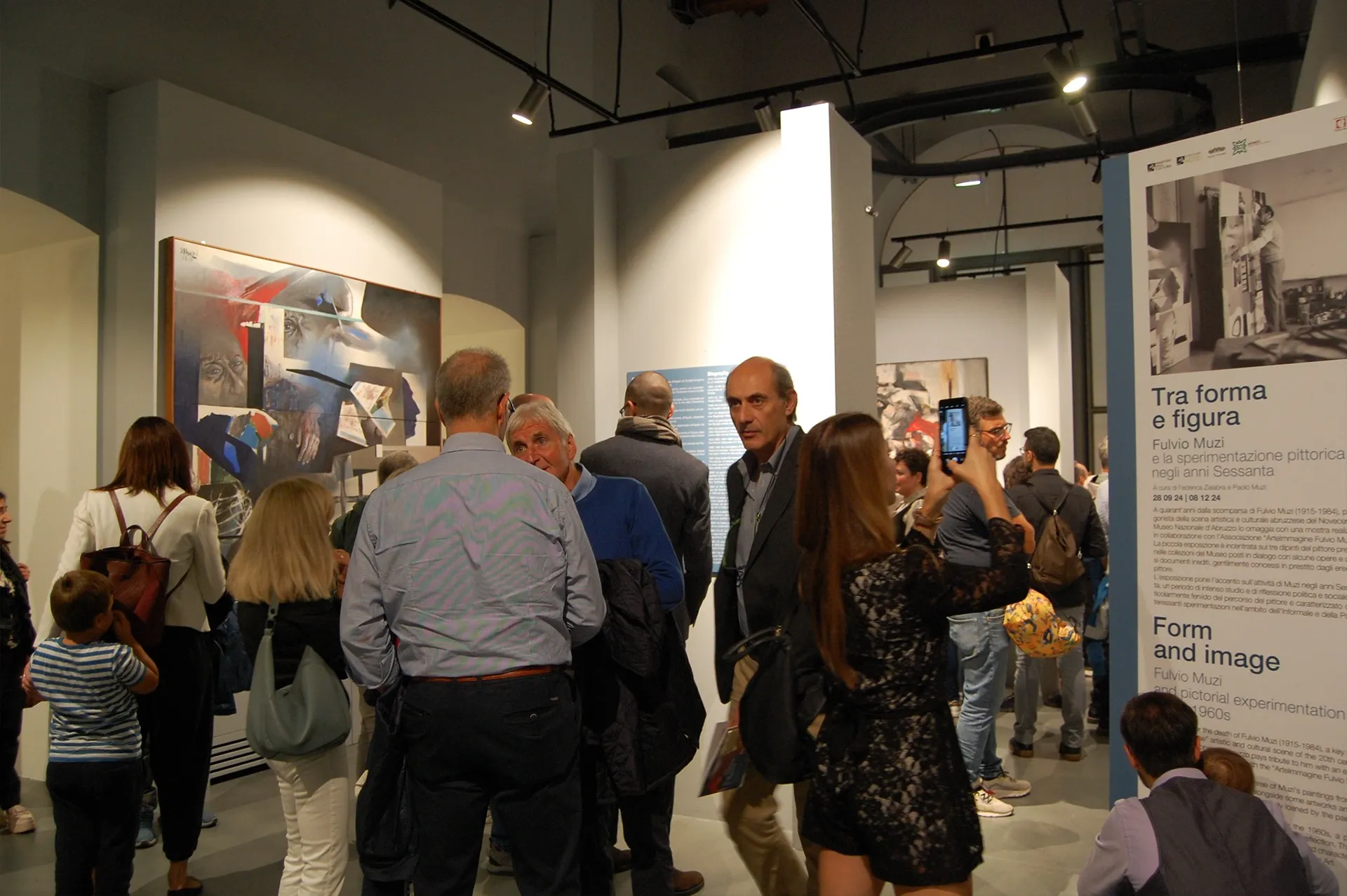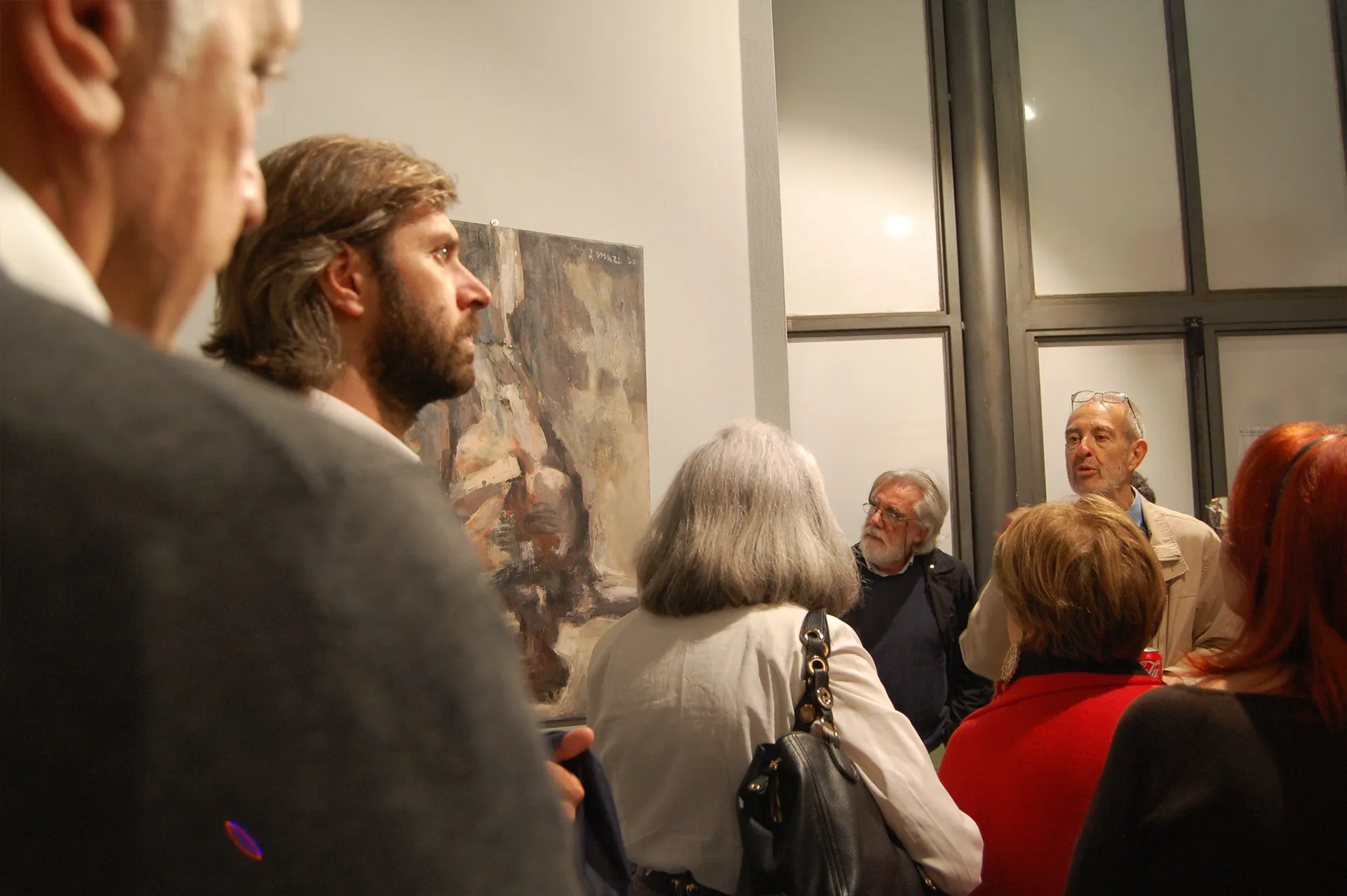

Forty years after the death of Fulvio Muzi (1915-1984), a leading figure in the 20th-century Abruzzo artistic and cultural scene, the National Museum of Abruzzo pays tribute to him with an exhibition organized in collaboration with the “ArteImmagine Fulvio Muzi” Association.
The small exhibition focuses on three of the artist’s paintings from the Museum’s collections, alongside several previously unpublished works and documents kindly loaned by the painter’s heirs.
The exhibition focuses on Muzi’s work in the 1960s, a period of intense study and particularly fervent political and social reflection in the painter’s career, characterized by interesting experiments in Informal Art and Pop Art.

Biography
1915: Fulvio Muzi was born on January 17th in L’Aquila to a family of artisans who helped introduce him to art.
1935: At the age of twenty, he won his first prize with “Self-Portrait,” a work presented at the Second Interprovincial Exhibition of Abruzzo and Molise.
1943-44: During the Second World War, Muzi fought on the Greek-Albanian front and then joined the Greek Resistance.
1945: He participated in the first exhibition of the Gruppo Artisti Aquilani, including a piano concert.
1947: He participated in the Abruzzo Regional Prize in L’Aquila, winning first prize with “Portrait of a Teenager.”
1948: He participated in the Fourth Art Exhibition organized in L’Aquila by the Gruppo Artisti Aquilani, of which he was a member.
1951: He participated in the Sixth National Quadrennial of Art at the Palazzo delle Esposizioni in Rome, where he returned in 1953 for the exhibition “Art in the Life of Southern Italy.” of Italy
1954-1962; 1967-1969: Participates in various annual editions of the F.P. Michetti National Prize in Francavilla al Mare
1955: The Municipal Art School – later the State Art Institute – is founded, named after the painter in 1999. Muzi’s long career as a teacher begins.
1957: Muzi is director of the restoration works of the church of San Lorenzo in Turin. His work as a restorer, which took him around Italy and which he combined with his work as an artist, allowed him to experience the stimulating artistic climate of the postwar period.
1960: He participated in the Homage to Chopin by painters and sculptors from L’Aquila in the Castello cinquecentesco of L’Aquila and in the III Biennale of Figurative Arts of Abruzzo and Molise, winning first prize and the “Soffrana d’oro.”
1962: He participated in the exhibition “De Sanctis, Mantovanelli, Marinucci, Muzi, Vetere” at the Galleria Sanluca in Rome, which was re-presented at the Galleria Alfa in Venice in 1963.
1963: He participated in “Ten Artists from Abruzzo Today,” an exhibition organized at the castle of L’Aquila in parallel with “Aspects of Contemporary Art,” an exhibition that introduced American pop artists a year before the 1964 Venice Biennale.
1965: He was elected councilor of the City of L’Aquila and participated in “Alternative Attuali 2.” International Exhibition of Painting, Sculpture, and Graphics at the Castello cinquecentesco of L’Aquila
1968: Participates in Alternative Attuali 3. International Exhibition of Contemporary Art at the Castello cinquecentesco of L’Aquila
1980 (June 15-22): A solo exhibition of his work, Fulvio Muzi, painter, is organized as part of the 1980 Scanno – Gian Gaspare Napolitano Prize for Figurative Arts in Scanno.
1982 (July 15-September 30): The retrospective exhibition Fulvio Muzi dal 1932 ad oggi: cinquant’anni di pittura (Fulvio Muzi from 1932 to today: fifty years of painting), curated by art critic Enrico Crispolti and hosted in the Castello cinquecentesco of L’Aquila, is organized.
1984: In June, the mural created by Muzi in the council chamber of the City of L’Aquila, commissioned by Mayor Tullio de Rubeis to commemorate the 40th anniversary of the city’s liberation from Nazi occupation, is unveiled. The artist died in August of the same year.
Fulvio Muzi in the 1960s
The figure has been the guiding thread of Fulvio Muzi’s pictorial production throughout his career. Between the late 1950s and early 1960s, after an overtly figurative and expressionist phase, the modes of Abstract Informalism responded to the painter’s personal urge for immediate expression.
Muzi himself, in fact, defines this period of his work as “a new recovery of spontaneity” because “the urgency of the painting is no longer mediated by any mental form (…)”. Despite this, the figurative component persists through the conceptual reference expressed in the titles of the works. This phase is represented by the works Figura (no. 7), Finestra (no. 3), Figure distese sulla sabbia (no. 8), Figure distese (no. 5).
The drawing Franco (n. 6), a work that portrays the painter’s son, dialogues with these paintings: the figure of the boy is sketched but recognisable while the thick line of the drawing, which conveys the vigour of the gesture and the charged materiality of the charcoal, refers to the methods of Informal painting.
Shortly after these works, an event that left a clear, albeit transitory, mark on Muzi’s painting occurred. In 1963, the exhibition Aspects of Contemporary Art, curated by Antonio Bandera and Enrico Crispolti, was held in L’Aquila’s Castello cinquecentesco.
On this occasion, for the first time in Europe, the new artistic movements of New Dada and Pop Art were presented through the works of 13 American painters. Muzi, a key figure in the city’s cultural and artistic scene, immediately embraced the innovations from overseas, producing works such as Fragments (no. 1), Interior (no. 2), and Portrait of a Man of the Resistance (no. 4).
Muzi experimented with new styles but absorbed only those models he deemed appropriate to his own poetics. For this reason, the Pop era of his work was brief, giving way in the 1970s to a phase of visionary realism, expressed through the depiction of figures suspended in the void and falling naked bodies, and to a line of research linked to the local landscape, which expressed the painter’s visceral relationship with the Abruzzo mountains.