

To know
About artworks
Title
Date
Dimensions
Origin
Collection
Location
Position
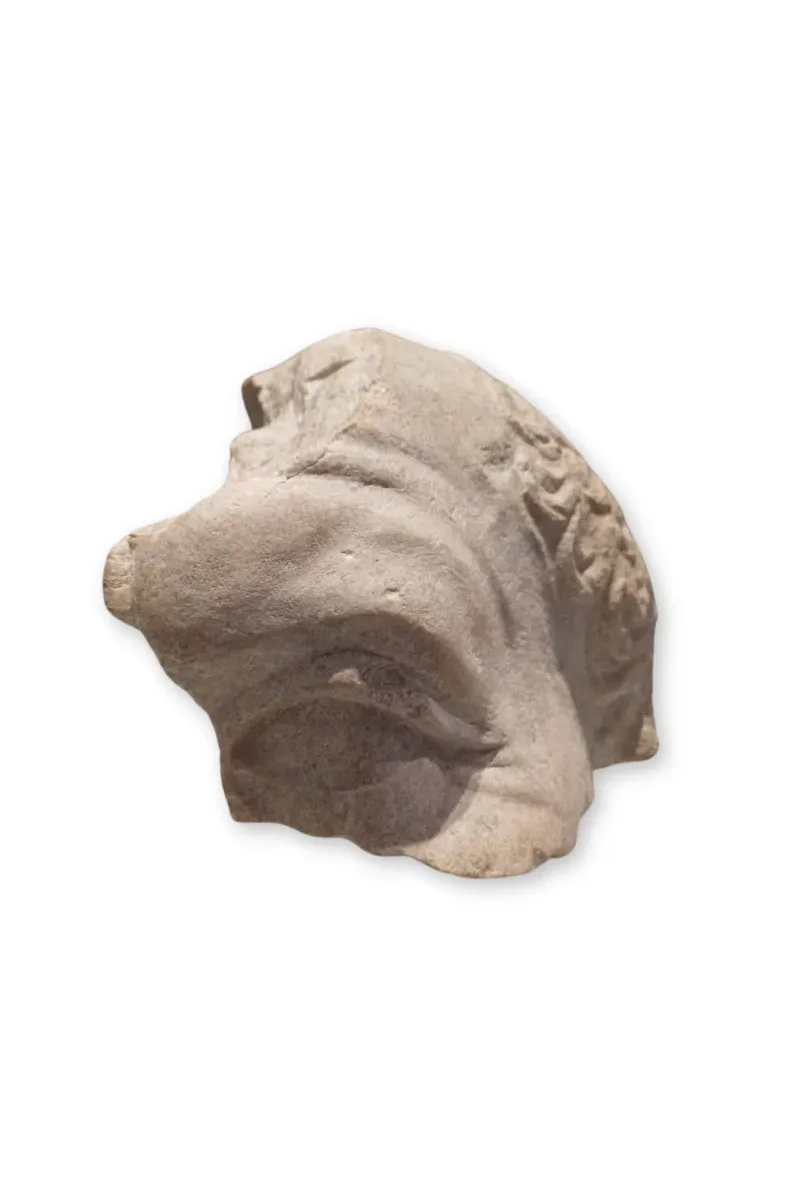
The portrait fragment of Emperor Vespasian, who reigned from 69 to 79 A.D., can be attributed to the so-called official series of portraits. In such portraits, the emperor’s facial features appear somewhat youthful and almost idealised, while signs of old age are present but softened: wrinkles, for instance, are only superficial. Nevertheless, there was no intent to radically alter his physiognomy. The head is solidly constructed, the wrinkles are still realistic, the hair is thinner at the forehead, the eye is sunken, and the eyelids are slightly puffy.
It is not clear when Vespasian began to be portrayed in this manner: the portrait type may have been introduced either at the beginning of his reign or posthumously. Like the two theatrical masks, this portrait was also found in the basin of a fountain located in front of the theatre of Amiternum during the 2014 excavations by the then Soprintendenza Archeologia, Belle Arti e Paesaggio of Abruzzo.
It is an intriguing possibility that a portrait of Vespasian was placed in the theatre to honour his dynasty—the Flavian family—originally from the province of Rieti, once part of the upper Sabina region, the same area as Amiternum.
If you care about the National Museum of Abruzzo and would like to help protect and enhance its collections, please make a donation.